Tuesday, December 10, 2024

Chinkokuji Temple 88 Kyushu Pilgrimage

Chinkokuji

Chinkokuji, the 88th temple on the Shingon Kyushu Pilgrimage lies just across the river from the Munakata Taisha shrine in northern Fukuoka.


In fact, it was the shrine temple of Munakata Taisha back when shrines and temples were intertwined.


According to the legend, Kobo Diashi visited Munakata Taisha and prayed for a safe journey to China, so when he returned in 806 he visited Munakata Taisha again.


While here a cloud formation over Mount Byobu attracted him across the river and he performed rituals in the cave that is the okunoin of the temple now.


He is also said to have carved the secret Fudo Myo statue that is now enshrined in the Goma Hall.


Three statues were carved an enshrined at some point, a Dainichi, a Shaka, and a Yakushi. I am guessing these coresponded to the three kami of Munakata Taishi.


The main hall now has five statues, as well as the original three there is an Amida and a Kannon.


All 5 are registered as Important Cultural Properties.


The Goma Hall is the oldest building at Chinkokuji, dating back to 1650.


I visited while the cherry blossoms were in full bloom, but I visited again on day 44 of the Kyushu Fudo Myo Pilgrimage in the autumn and it was splendid in Fall foliage. I took a lot more photos then, including the statues in the main hall.


This was the final temple of this more than 2,000 Kilometer pilgrimage, though technically the Okunoin at the top of the hill is number 108. I post on that next.


Chinkokuji has a reputation as a "flower temple", because as well as the chetry blossoms and the autumn foliage, there are also plum blossoms,azaleas, lillies, and lotus blossoms, hydrangeas, and rhododendrums.


Goods From Japan

Sunday, December 8, 2024

Chokoji Temple 10 Iwami Kannon Pilgrimage


Chokoji is a Soto sect Zen temple in a remote area of Iwami that has a deep connection with the Iwami Ogasawara Clan.


The temple was founded in the 14th century and seems to have been originally a site founded by the clan as a spot for samurai to recover from wounds. A wooden pillow held by the temple was a gift from Ashikaga Yoshitane to Ogasawara Nagataka for his help in the Battle of Kyoto in 1508


The Ogasawara were not a big clan but were given the domain to protect the Iwami coast following the Mngol Invasions. As the Warring States Period increased the power of the nearby Amago and Ouchi Clans the Ogasawara switched allegiances several times and eventually submitted to the Mori.


Chokoji was the family temple for the clan. The honzon is a Shaka Nyorai, and the Kannon for the pilgrimage is in its own Kannon-do (photo 6).


Nowadays, it is known primarily for the huge Gingko tree in the grounds that creates a golden carpet in late Autumn. I highly recommend this post on the autumn colors here.


The previous post was on the walk to Chokoji from Kannabiji.


Friday, December 6, 2024

Munakata Taisha


I passed through the grounds of Munakata Taisha on my way to the final temple on the Kyushu Pilgrimage.


I entered through the rear entrance and passed by the Second Shrine and Third Shrine housed in structures that were relocated here from the rebuilding of Ise Shrine in 1973.


Munakata Taisha is actually three different shrines, the biggest here on the mainland is Hetsu-gu, with the Nakatsu-gu just offshore on Oshima, and the third, Okitsu-gu located 50k away on the small island of Okinoshima.


These second and third shrines were established to make it easy for people to visit all three without having to make a ferry crossing, and also because the Okitsu-guis is an uninhabited island where women are not allowed.


The three kami are sisters, Ichikishimahime, the youngest, here, Tagitsuhime on Oshima, and Tagorihime, the oldest, on Okinoshima.


Ichikishimahime is the primary kami of the famous Itsukushima Shrine and its branches.


The three sisters were created by the siblings Susano and Amaterasu. The male children created were attributed to Amaterasu and include the mythical lineage of the imperial family. The three females were given to Susano, though some with a nationalistic bent claim them also for Amaterasu, forgetting that to do so would put the imperial lineage under Susano....


The three shrines and islands were very important in trade and travel between Japan and Asia, and the three sisters are usually considered protectors of maritime journeys.


The rituals that were conducted on Okinoshima between the 4th and 9th centuries have left a wealth of archeological treasures, sone of which can be seen in the museum here.


It has also led to Okinoshima being registered as a UNESCO World Heritage site.


The ancient Munakata Clan were obviously powerful players in the introduction of technology and culture from the Korean Peninsula and mainland China.


On this visit I was in a hurry so didn't visit the main shrine compound, rather enjoyed the cherry blossoms around the pond at the entrance.


The previous post was on Munakata Kannonji Temple.


Thursday, December 5, 2024

Mishima Shrine Takaoka Tosa


Mishima Shrine is located in Takaokacho, Tosa, at the base of the hill on which Ohenro temple 35, Kiyotakiji is found.


It shares space with an Itsukushima Shrine, though they each have their own steps.


The only history I can find is that it was rebuilt in the early 17th century.


There are numerous smaller shrines within the grounds, including a Yasaka Shrine enshrining Susano, and a Shinmei Shrine enshrining Amaterasu.


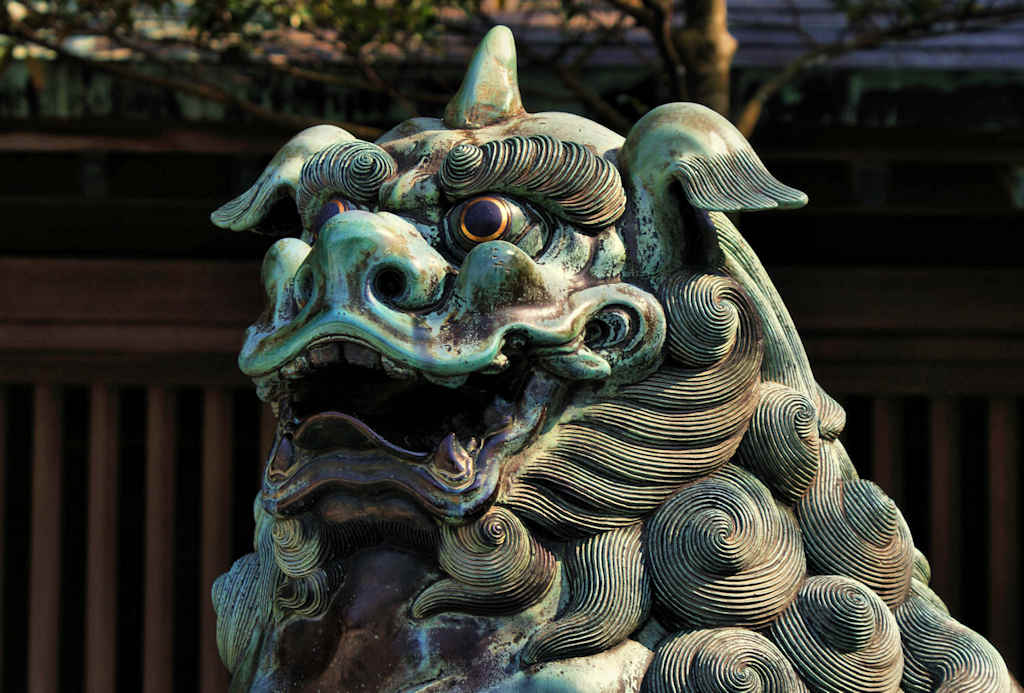
There are half a dozen komainu including several with the "Princess leia" hairstyle.


There are a lot of largish ema paintings, including one, not shown as it is too faded, registered as an Important Cultural Property.


The Mishima shrine enshrines Oyamazumi.


The Itsukushima Shrine enshrines the three Munakata Princesses, daughters of Susano.


The previous post in this series documenting the space between the temples on the Ohenro Pilgrimage was on the nearby Omirokusama Shrine.


Wednesday, December 4, 2024

Munakata Kannonji Temple 87 Kyushu Pilgrimage


Temple number 87 is yet another relatively modern temple. Its origins lie in 1953 when a monk, Zenkai, enshrined a Kannon statue here.


While working as a merchant seaman he had visions of Kannon that instructed him to continue the work of a monk who had founded a temple at this spot in the 17th century but the temple fell into disuse and disappeared.


Later, Zenkai's wife became a nun and she is the current head priest.


There is an Inari shrine in the grounds and a  Jizo. The Jizo is part of the 24 temple Kyushu Jizo Pilgrimage.


The current main hall dates to 1996. It became a Shingon temple in 1980. Statues of Zenkai and his wife are the last photo.


The previous post was on Miyajidake Shrine, about 5k to the southwest.