Showing posts with label tagitsuhime. Show all posts
Saturday, August 9, 2025
Kawada Hachiman Shrine
Labels:
ema,
Hachiman,
ichikishimahime,
shikoku fudo,
shimenawa,
Shrine,
tagitsuhime,
tagorihime,
tokushima,
torii
Wednesday, March 12, 2025
Achi Shrine Kurashiki
Myoken was a very popular shrine in Japan, dedicated to the Buddhist deity of the North Star. When most Myoken shrines were changed in 1868 they switched to a pair of obscure kami from the Kojiki. Why they chose the Munakata Kami here is a mystery.
Labels:
chinowa,
chugoku33,
daruma,
ichikishimahime,
inari,
kurashiki,
okayama,
okuninushi,
shimenawa,
Shrine,
Susano,
tagirihime,
tagitsuhime,
tenjin,
torii
Friday, December 6, 2024
Munakata Taisha
The three kami are sisters, Ichikishimahime, the youngest, here, Tagitsuhime on Oshima, and Tagorihime, the oldest, on Okinoshima.
The three sisters were created by the siblings Susano and Amaterasu. The male children created were attributed to Amaterasu and include the mythical lineage of the imperial family. The three females were given to Susano, though some with a nationalistic bent claim them also for Amaterasu, forgetting that to do so would put the imperial lineage under Susano....
The ancient Munakata Clan were obviously powerful players in the introduction of technology and culture from the Korean Peninsula and mainland China.
Labels:
fukuoka,
ichikishimahime,
koi,
komainu,
kyushu108,
munakata,
Sakura,
Shrine,
tagitsuhime,
tagorihime,
takiribime
Monday, July 13, 2020
Shrine of Sogi Falls
Sogi Taki no Jinja is on the south side of the Sogi Waterfall and is now housed in a recent rebuild. The construction if the new bridge over the falls entailed lots of road construction so I guess that was why it was rebuilt.
It is said that the guardian of the falls is enshrined here, and it is listed as Takitsuhime, a variant on Tagitsuhime, who was one of the 3 Munakata Princesses, offspring of Susano and Amaterasu that are normally known for guarding sea journeys.
I spent the night here, sleeping under the overhanging eaves as after dark a heavy mist descended for the night, and though it didn't actually rain, water dripped off the roof all night. early next morning when I set of on the 38th day of my walk the mist was still thick.
Labels:
kyushu108,
Shrine,
tagitsuhime
Sunday, February 1, 2015
Junisho Shrine
Junisho Jinja
Labels:
Amaterasu,
amenohohi,
ichikishimahime,
ikutsuhikone,
izanagi,
izanami,
izumo33,
kojin,
komainu,
Konohanasakuyahime,
kumanokusubi,
Shrine,
Susano,
tagitsuhime,
takigihime
Monday, September 6, 2010
Tarumi Shrine
Tarumi Shrine is a fairly standard village shrine located in Kawashima, the fishing village at the base of the mountains below Gakuen-Ji.
I once spent a night onboard a small yacht in Hawashima harbor during a typhoon.... but thats another story.
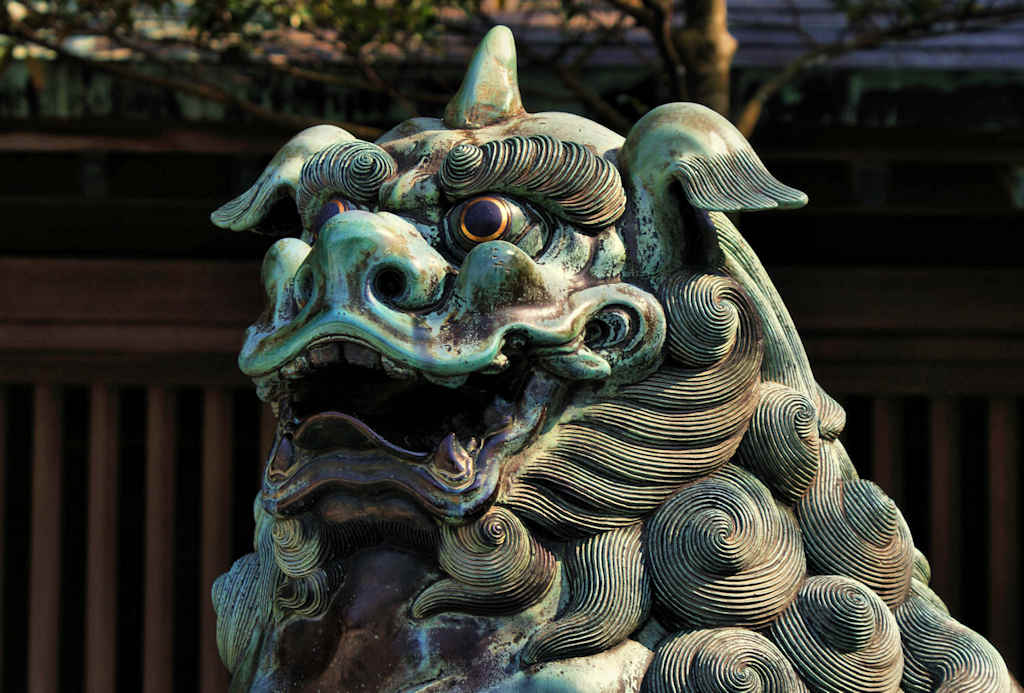
Izumo-style komainu are recognizable by their stance,... with their butts in the air.
The main kami of the shrine is Tagitsuhime, one of the 3 Munakata Sisters. Daughters of Susano, they were protective deities of the sea journey between North Kyushu and the Korean Peninsular, and so have associations with protection at sea.
I have visited the head shrine of Tagitsuhime, on the small island of Oshima just off the coast at Munakata.
her name seems to be derived from "rough water"
There is a secondary shrine to Inari, and a small Aragami shrine.
Labels:
aragami,
inari,
Izumo,
Shrine,
tagitsuhime
Monday, December 29, 2008
Itsukushima Shrine, Setogashima, Hamada
Setogashima is a tiny island in the harbor of Hamada. The Itsukushima shrine is the only shrine on the island. The three sisters enshrined here (daughters of Susano) are known to be protectors of fishermen, so Itsukushima shrines are common in fishing villages.
The 3 home shrines of the Munakata sisters are located in north west Kyushu, one on the mainland, and the other 2 on 2 small islands. The Munakata clan were responsible for protecting the sea lanes between Kyushu and the Korean peninsular.
The shrine has no secondary shrines within its precincts, and no kagura den, so for matsuri they use the nearby Shimoyama Inari Shrine. The channel seperating Setogashima from the mainland is only a stones throw wide, so a small bridge connects it, but still a huge multi-million dollar bridge was constructed.
It's actually a very quiet, picturesque fishing village of a few dozen houses, and as one of the main harvests in this area is squid, it's not surprising to see squid drying in the sun.
Labels:
Hamada,
ichikishimahime,
itsukushima,
Iwami,
setogashima,
shinto,
Shrine,
tagitsuhime,
tagorihime
Subscribe to:
Comments (Atom)