Tuesday, September 22, 2009
Scary protectors
It took me a long time to find out about this statue as I can find nothing similar anywhere else. It is located in Mitaki Dera, my favorite site in Hiroshima City. Many people refer to it as a Nio, but it is not. It is one of the Shitenno, the 4 Heavenly Kings.
Originally Hindu deities, in Japanese buddhism the shitenno are associated with protection of the 4 directions. Tamonten, also known as Bishamonten, is probably the most well known of the shitenno. Which of the four this one is I don't know.
The clue that it is a shitenno and not a nio is that under its foot, and in this particular statue also being hurled from its left hand, are Jaki ( or Jyaki), a type of demon or malevolent spirit.
Labels:
hiroshima,
jaki,
mitakidera,
shitenno,
temple
Saturday, September 19, 2009
From the forest
Kuri, Japanese Chestnuts, are starting to fall from the trees now. It's an indigenous tree of the Japanese islands, and the nuts have been consumed for thousands of years. Along with bamboo shoots and mushrooms, it is one of the most avidly harvested wild foods and people rarely divulge the location of their favorites trees. Kurigohan, rice cooked with chestnuts, is a common dish at this time of the year, and kuri are used extensively in sweets and confectionery.
These not particularly appetizing-looking fruits are Akebi, with the curious name of Chocolate Vine in English. Not collected much anymore as they are not very sweet and mostly seeds, but were popular in earlier times when the Japanese had less sugar in their diet. The bears and monkeys continue to love them.
Tuesday, September 15, 2009
Almost the 7 Lucky Gods of Japan
I found this eclectic tableau at the entrance to Suisei-en on the yamanobenomichi.
The figure on the far left is Hotei, one of Japan's 7 Lucky Gods (Shichi Fukujin), and is associated with abundance and good health. He came from China where he is named Budai, and is also known as the laughing Buddha, which is the name I associate him with as I had a small statue of him when I was young.
The gentleman in the middle back is Fukurokuju, another member of the Shichi Fukujin, and he is associated with wisdom and longevity and probably derives from a Chinese star God, Shou.
To the right stand 2 tanuki, who are not gods or kami, but have existed in Japanese folklore since ancient times as shape-shifters. They are also associated with good fortune.
In the center are Daikoku and Ebisu, both members of the Shichi Fukujin and often equated with Okuninushi and Kotoshironushi. Daikoku is the god of wesalth, commerce , and trade, and is derived from the Hindu God Shiva. Ebisu is the god of fishing and merchants, and is usually believed to be the only one of the Shichi Fukujin not from India or China.
The 2 snakes in the front I'm not sure about. Snakes have many connotations in Japan, especially water, so they may be representations of Benzaiten, one of the Shichifukujin associated with music, art, and eloquence. Based on a Hindu River God, Saraswati.
Labels:
benzaiten,
daikoku,
ebisu,
fukurokuju,
hotei,
schichifukujin,
suiseien,
tanuki,
yamanobenomichi
Friday, September 11, 2009
Kobe Port Tower
Opened in 1963, the Kobe Port Tower soon became a symbol of the city of Kobe.
Designed by the Nikken Sekkei Company, the design is based on a Japanes drum, the Tsuzumi, and was the first tower built using a pipe lattice.
The tower is 108 metres high, and the observation platform is at 90 metres.
The tower is open every day of the year and entrance is 600 yen.
Labels:
Architecture,
kobe,
nikken sekkei
Tuesday, September 8, 2009
Hikawa Town
Hikawa Town lies along the Hi River (Hikawa) in Izumo.
The red iron sand of the Hi was one of the earliest sources of domestic iron production in Japan, and the site of the Yamata no Orochi legend, both associated strongly with Susano.
The design of the manhole cover is of Dotaku, bronze bells from the late Yayoi Period (2nd and 3rd centuries) and reflect the large number of archeological sites associated with this ancient part of Japan.
Not much is known for sure about dotaku, though they were probably ritual objects used in early agricultural rites, and that they were introduced, like so much in early Japan, from Korea.
They have been excavated all over Japan, usually singly, but not far from Hikawa at Kamo Iwakura, a cache of 39 were discovered.
I took the photo ofthe manhole cover at the entrance to Kojindani, an archeological site even greater than Kamo Iwakura. Bronze ritual swords were also used in similar ways to dotaku, and all over Japan more than 300 of these swords had been excavated in total. At Kojindani in 1984, 358 swords were uncovered in one spot!!!
The importance of Izumo as an early political and cultural center of ancient Japan was underscored.
There is a small museum at Kojindani, but the 385 swords themselves are on display at the nearby Shimane Museum of Ancient Izumo.
Thursday, September 3, 2009
Hibara Shrine
Hibara Shrine lies on the Yamanobenomichi at the base of Miwa-san. It is an affiliate shrine of Omiwa Shrine, and like it, enshrines the kami of the mountain, now reckoned to be Okuninushi.
There are no buildings at Hibara Shrine. Buildings at shrines only began after the introduction of Buddhist temples.
Amaterasu was worshipped here but it seems that after Okuninushi was installed from Izumo there were problems between the two of them, so Amaterasu was moved to Ise.
This small shrine was added in 1987. Called Toyosuki-iri-hime no miya. Toyosuki iri hime was an imperial princess who was the "priestess" in charge of the mirror that was the shintai ( god body) of Amaterasu.
Labels:
Amaterasu,
nara,
okuninushi,
shinto,
Shrine,
yamanobenomichi
Monday, August 31, 2009
Monsters in the garden
Found a whole bunch of these critters under some rotting wood.
I gave them to a friend's sons, because they ( the critters, not the boys) turn into.....
...one of the most popular pets for young boys in Japan, Kabuto Mushi.
It's the biggest beetle in Japan, and Kabuto means "samurai helmet".
In English we call them Rhinocerous Beetle.
I found this monster after it had eaten half of one of my tomato plants. We get a few every year, but this one was the biggest I've seen,... it was as long as my hand. If it was in the U.S. it would become a Luna Moth. Not sure what they become here.
Labels:
garden,
kabutomushi,
Shimonohara
Saturday, August 29, 2009
An umbrella at Matsuo Shrine
Just 4 shots of a red Japanese umbrella I saw at Matsuo Shrine near Kyoto.
My favorite is the last one.
Labels:
matsuo shrine,
umbrella
Friday, August 28, 2009
Looking down on mom.
One of the reasons our Turkey trip was so cheap, I think, is because we flew with Uzbekistan Airways. After spending 4 hours in the middle of the night in the holding tank that is Tashkent Airport Transit Lounge, the leg of our flight to Istanbul flew over some amazing country.
Not sure what they are mining here in the middle of the desert.
Another very noticeable man-made mark upon the earth.
Whenever I travel I spend the whole time with my nose stuck to the window. I was lucky enough to have a window seat, clear skies, and low light of the early morning.
I think these very high mountains were in Georgia.
Another mine, this time in Turkey
The suburbs of Istanbul.
To see the whole sequence of 42 photos, please click below
Labels:
ariel,
turkey,
uzbekistan
Wednesday, August 26, 2009
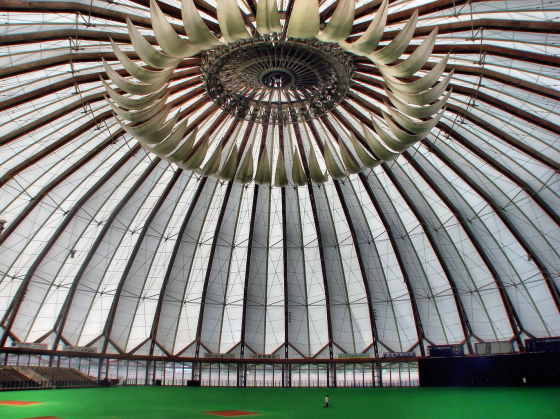
Izumo Dome. One of he biggest wooden buildings in Japan.
Labels:
Architecture,
Izumo
Subscribe to:
Comments (Atom)