Showing posts with label sanno. Show all posts

Friday, October 23, 2026

Okanari Shrine & Akamatsu Hiyoshi Shrine


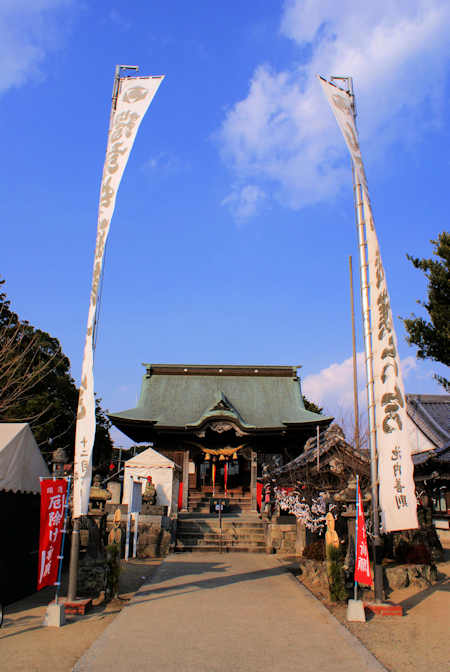
A little farther up the lower slopes of Mount Daisen, I came to Okanari Shrine.


When this area was being settled and developed, three shrines of the Kumano Sanzan were founded, this one being for Shingu Daimyojin, so the kami here is Hayatamano.


The village was originally named Shingu, but later was renamed Okanari. During the 16th century the shrine was supported by the local warlord, a vassal of the Mori.


In the late Edo Period the shrine functioned as a subsidiary shrine of Ogamiyama Shrine.


In early Meiji the name was chnged from Shingu Daimyojin to Okanari Shrine.


Within the grounds is a Yamaguchi Shrine enshrining Susanoo, Oyamatsumi, and Inari.


A little further, in the village of Akamatsu, I came to a Hiyoshi Shrine. There are no records of its founding, except that as Sanno Gongen, the original name for Hiyoshi Shrines, it has been there since ancient times.


The kami are Okuninushi, Oyamatsumi, Toyotamahime, Ojin, & Inari


In 1913 all the other shrines in the village were merged with Hiyoshi Shrine.


A Myoken shrine, an Ikenojinja Shrine, an Ichinotani Shrine, and an Otani shrine combined to create the mix of kami mentioned above.


The shrine is home to a unique festival tradition the Akamatsu Kojin Festival, held only in leap years, and an Intangible Folk Cultural Tradition. In it a 25 meter long serpent made of straw is carried through the village and then placed at the Kojin altar in the shrine.


This is obviously an extension of the Kojin straw serpents found at just about every shrine in Izumo, and the equivalent of Omoto in our region of Iwami. Straw serpents can be found in most parts of Japan and usually represent the local land kami.


The previous post was on Ogamiyama Shrine.


If you would like to subscribe by email, just leave your email address in the comments below. It will not be published or made public. I post new content almost every day, and send out an email about twice a month with short descriptions and links to the last ten posts

Thursday, October 13, 2022

Ogori Hiyoshi Shrine

Ogori Hiyoshi Jinja


Monkeys are the messengers of Hiyoshi shrines, so its not surprising that at the Ogori Hiyoshi Shrine in Ogori, Fukuoka,  there are monkey statues around the grounds.


It is one of almost 4,000 branches around Japan of Hiyoshi Taisha located at the base of Mount Hiei in Shiga.


Before the Meiji period many of the Hiyoshi shrines were called Hie Shrine or Sanno Shrine, as the shrine was based on the Sanno cult, or Mountain King.


The cult was a kami cult based on Tendai Buddhism and the main kami was Oyamakui, and when the imperial court moved to the area temporarily in the late 7th century (in fear of attacks from Korea), Okuninushi was added, though as the area was earlier settled by Korean immigrants there was certainly Korean "kami" in the mix also.


The main building of the Ogori Hiyoshi Shrine had some really nice carvings.


The shrine seemed to be quite popular which usually indicates "this worldly benefits" and several of the monkey statues had babies. There was also a tall tree that had split into two trunks, commonly a symbol of marriage.


There was also a set of statues of the # Wise Monkeys, and while they are not purely of Sanno Shinto origin, several of the strands that make up their origin in Japan have strong Tendai connections.


Monday, June 6, 2011

Hiyoshi Taisha part 2

sakamoto38

The first shrine building to be built here was probably built around the latter part of the seventh Century. For a brief period the “ emperor” known as Tenji moved his court from the Yamato Plain to Otsu a few miles south of Hie, and he brought with him and enshrined in what is now the western compound of Hiyoshi Taisha the kami of Miwa, Onamuchi, the Yamato aspect of Okuninushi. So both of the first kami enshrined here trace their roots to Izumo.


sakamoto28

The Mikoshi of Hie are quite famous, and a special storeroom/museum exists to display examples of older ones. Enryaku-ji had become a powerful economic and political force by the 12th Century, and the monks used the mikoshi to “attack” Kyoto to coerce the government to accede to demands. The mikoshi were taken up and over Hiezan and the monks marched on Kyoto and left the mikoshi at various points around the city. Kami were feared as well as revered, and fear of the anger of the kami in the mikoshi put pressure on the government.


sakamoto32

Under the control of the Tendai monastery Enryaku-ji there developed the cult of Sanno at Hie. Known as the Mountain King, developed from the center of Tendai in China, the messenger of Sanno is the monkey.

sakamoto34

In all a total of 108 upper and 108 lower shrines were constructed here. 108 is a significant number in Buddhism. many of the shrines have long gone, but many remain. Some of the shrines are Usa, enshrining hachiman, Shirayama, enshrining Izanagi and Izanami, Otoshi, the father of Oyamakui, the shrines main kami , and a Suga, enshrining Susano, Oyamakuis grandfather.

sakamoto40

The frounds of Hiyoshi are very large and many visitors come for the Fall foliage. There is even a restaurant and tea room within the forest.

sakamoto41

Hiyoshi has a unique torii. Often referred to as symbolizing the mountain, the triangle actually symbolizes the unity of buddhas and kami. It was removed in 1869 with shinbutsubunri, but reinstated after WWII.