Showing posts with label oyamakui. Show all posts

Tuesday, September 15, 2026

Saka Shrine Origin of Sake in Japan


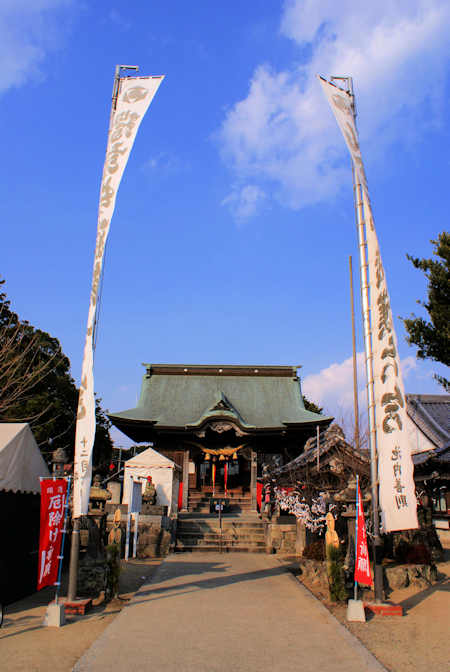
Down below Ichibata Yakushi Temple, and not far from Ichibataguchi Station, is Saka Shrine, sometimes called Matsuo Shrine.


October 2nd, 2015, and this is where I start day 43 of my walk along the Chugoku Kannon Pilgrimage.


This is an ancient shrine connected to the production of Sake, and the areas around it all have names connected to sake.


The first time sake is mentioned in the ancient myth-histories published in the early 8th century is when Susanoo brews some sake to give to the Orochi serpent, which he then slays when they are in a drunken stupor. As sake is a word used for alcohol in general, it is suggested that the sake he brewed was made from fruit.


However, same books, plus the  Izumo Fudoki, published a few years later, has a legend from this area wherein 180 kami gathered together, built a kitchen and brewed up some sake, and had a 180-day feast.


About ten kilometers away up the Hi River is Mankusen Shrine, where a big group of kami gathers during Kamiarizuki, the annual meeting of almost all of Japan's kami in the Izumo area. The shrine has a unique ritual and ceremony wherein the kami are kind of pushed out of the shrine because they won't leave. The reason they won't leave is that they say the sake here is so good.


The primary kami of Saka Shrine is Kushinokami, believed to be another name for Sukunahikona, the sidekick of Okuninushi who settled and created the land of Izumo. He was also linked with medicine. Also enshrined here are 180 unnamed kami, obviously a nod to the myth-legend.


At some point before the 16th century, the kami of Matsuo Shrine near Kyoto was enshrined here. Oyamakui is also considered the kami of sake, and Matsuo Shrine in Kyoto is considered the main sake-brewers' shrine in Japan. Saka Shrine was known as Matsuo Shrine until the Meiji Period, when it reverted to Saka Shrine.


Researchers and historians believe that sake was introduced into Japan from Korea via Izumo. The Hata Clan created the Matsuo Shrine in Kyoto, and the Hata are known to be an immigrant clan from the mainland; some say China, some say Korea, some say even further west. Many historians suggest that the Hata spent some time in Izumo before moving on to Yamato. All this suggests that the area around Saka Shrine may well be the origin of Sake in Japan...


Sake brewers continue to support and pray at Saka Shrine. At the annual festival in mid October, at which the head priest has brewed sake for it, many sake brewers gather. The shrine has a special license to brew the sake.


In the grounds are numerous secondary shrines, notably an Inari.


There are also an Ekisha, a Takeuchi Shrine, and a Hoden Shrine. The most interesting is a Smallpox Vaccination Shrine.


The previous post in this series was on the 84,000 Yakushi statues at Ichibata Yakushi. Well worth a look!


If you would like to subscribe by email, just leave your email address in the comments below. It will not be published or made public. I post new content almost every day, and send out an email about twice a month with short descriptions and links to the last ten posts

Thursday, October 13, 2022

Ogori Hiyoshi Shrine

Ogori Hiyoshi Jinja


Monkeys are the messengers of Hiyoshi shrines, so its not surprising that at the Ogori Hiyoshi Shrine in Ogori, Fukuoka,  there are monkey statues around the grounds.


It is one of almost 4,000 branches around Japan of Hiyoshi Taisha located at the base of Mount Hiei in Shiga.


Before the Meiji period many of the Hiyoshi shrines were called Hie Shrine or Sanno Shrine, as the shrine was based on the Sanno cult, or Mountain King.


The cult was a kami cult based on Tendai Buddhism and the main kami was Oyamakui, and when the imperial court moved to the area temporarily in the late 7th century (in fear of attacks from Korea), Okuninushi was added, though as the area was earlier settled by Korean immigrants there was certainly Korean "kami" in the mix also.


The main building of the Ogori Hiyoshi Shrine had some really nice carvings.


The shrine seemed to be quite popular which usually indicates "this worldly benefits" and several of the monkey statues had babies. There was also a tall tree that had split into two trunks, commonly a symbol of marriage.


There was also a set of statues of the # Wise Monkeys, and while they are not purely of Sanno Shinto origin, several of the strands that make up their origin in Japan have strong Tendai connections.


Monday, May 11, 2020

Dangyo Shrine & Waterfalls


Deep in the forested mountains of the interior of Dogo, the largest of the Oki Islands, are Dangyo Shrine and its pair of waterfalls. Just outside the torii are a pair of huge, ancient trees. The story is that when Izumo Taisha was being rebuilt the shrine was ordered to supply any such trees for timbers for the construction. The local people moved the torii forward some meters so that the trees then fell outside the shrine grounds and so were spared the felling.


There are two waterfalls here. The smaller is considered female and the larger male. With Japan's obsession with ranking, the waters here are ranked one of the 100 Best Waters of Japan. The water from the female waterfall is considered "winners" water, and is drunk by competitors in human nad bull sumo tournaments.


a couple of small shrines are inside the overhang over which the male waterfall cascades. The male kami here is Oyamakui, an Izumo kami who is famously enshrined at Hie Taisha below Enryakuji. The female kami is Seoritsuhime, not a well known kami but said to be the kami of waterfalls, rapids etc.


Bronze mirrors and other artifacts have been excavated here suggesting that this has been a sacred site since prehistory. Well worth the effort needed to visit, as are all the Oki Islands.


Thursday, April 28, 2016

Hiyoshi Shrine, Nogata


In the north of Nogata in the village called Ueki, I came across this small Hiyoshi Shrine, one of about 4,000 branch shrines of Hiyoshi Taisha, the shrine complex associated with Enryakuji on Mount Hiei, and the origin of the Sanno Shinto sect.


The two kami enshrined in Hiyoshi shrines are Oyamakui and Okuninushi, corresponding to the east and west shrines at Hiyoshi Tasiaha.  Both are from in the Susano lineage, and Oyamakui being associated with the Korean immigrants who founded the first shrine at Hiyoshi.


One of the pairs of komainu were unusual, one standing upright, and the other, pictured here, doing a "handstand". These types can often be seen in a small ceramic form on shrine or temple roofs.


There was no signboard at the shrine so I have no idea about its history or secondary shrines in the grounds, but in one small shrine I did find a worn, wooden figure, though I dont know who it represents.


Inside another of the open shrines was a multicolored stripey rock and in front of it an inari, an Ebisu, and a Daruma... 


I visited on December 28th, and so the banners were probably in preparation for the New Year shrine visits


Thursday, April 3, 2014

Sanja Shrine


Sanja Shrine is right next door to Manpukuji and I came into the shrine from a trail that lead from the temple.
Sanja means " Three kami", and the three enshrined here are Izanagi, Hayatamano, and Kotosakano.


Izanagi is well known but the other two are known only in an alternate version of the myth that has Izanagi visiting his deceased wife Izanami in the underworld, Yomi. When he left Yomi Izanagi swore and oath of divorce from Izanami, he then spat. From the spittle was created Hayatamano who is the main kami of the famous shrine with his name in Kumano.


Also appearing at that time was Kotosakano, full name Yomotsu Kotosakanoo, which means " The man of words of separation of Yomi". I have encountered this triad of kami at other shrines in Izumo and Iwami.


Also enshrined here is Oyamakui, a grandson of Susano through Otoshi, and the main kami of Hie Taisha and Sanno Shinto. There is also an Aragami-sha, pictured above.


This area I am walking through is at the heart of Orochi country, and according to local people following the destruction of Orochi by Susano the people danced a celebration at this spot that later became this shrine.

Monday, January 20, 2014

Mishiro Shrine

Mishiro Jinja


Mishiro Shrine is less than 1k from Yaguchi Shrine, and like it is also listed in the Izumo Fudoki and is a shikinaisha, a shrine receiving offerings from the central government in the Heian Period and therefore listed in the Engi Shiki.


Like Yaguchi, it enshrines Susano, but also his "wife" Kushinada, and a grandson Oyamakui, son of Otoshi. Like many of the offspring of Otoshi, Oyamakui has strong links with Korean immigrfant groups in ancient Japan. Oyamakui is the original kami of Mt Hiei and what is now Hiyoshi Taisha. Oyamakui also has connections to the Hata and kamo clans, 2 very powerful immigrant clans .


There is a zuijinmon containing a fine pair of zuijin and their attendant, small, wooden komainu which have a most definite "cute" appearance.


There are 2 smaller shrines within the grounds, an Inari Shrine, and a Takasa Shrine which enshrines Aohatasakusahiko, and all I can find out about him is that he was one of the numerous offspring of Susano.


Saturday, December 8, 2012

Omiwa Shrine, Tokushima


h401

Coming to the end of my fourth day on the Shikoku Pilgrimage, between temple 17 and 18 it began to rain so I took shelter in this large shrine.

h402

It is believed to be a branch shrine of the famous Omiwa Shrine in Nara, though it was written with different kanji, but the main kami is Onamuchi, more commonly known as Okuninushi, the main kami of the Nara Omiwa Shrine.

h403

It is an old shrine, being listed in the Tenth Century Engishiki, and it is also a "soja", a shrine where the local government official gathered together all the shrines of a district into one site so he didnt have to travel around to visit them annually.

h408

Small shrines like this surrounded by water are usuallky a Suijin or Benten shrine. This one is an Enoshim-sha, the main kami of Enoshima Jinja being Benten.

h406

The second kami enshrined here is Oyamakui, one of the kami of Hietaisha, a grandson of Susano, and known to be a kami worshipped by immigrant clans in ancient Japan. Interestingly, to me at leat, that the two main kami are both Izumo kami.