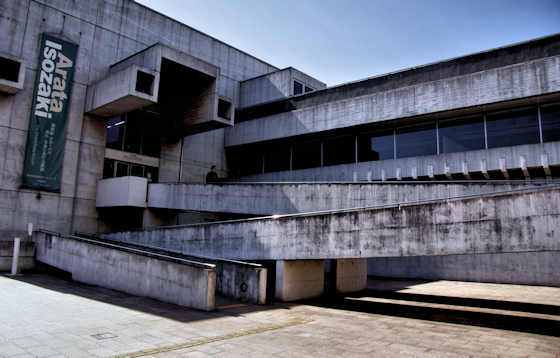
Showing posts with label Arata Isozaki. Show all posts

Sunday, January 25, 2026

More AIAV by Isozaki


The Akiyoshidai International Art Village is a major project of renowned Japanese architect Arata Isozaki.


It is located in a narrow valley below the Akiyoshidai Karst and near to Akiyoshido, the biggest cavern in Japan.


In the previous post I showed you the ancillary buildings that include a copy of one of  Isozaki's earliest works. In this post I look at the large main building.


It was quite eerie exploring as there was not a single other person around.


Most of the doors were locked....


I would have liked to have seen the main auditorium, capable of seating 300. It has a very unusual layout and has three floors. The space can be rearranged to make any part of it the stage.


To the rear is an outdoor performance area. This has a fan-shaped grassy slope that enables up to 600 people to view a performance.


There is a central courtyard that has a square stage in the middle of shallow pools of water. Some of the rooms facing the courtyard can open up to blur the distinction between inside and outside.


There is a large gallery for exhibiting visual arts, but there was no exhibition when I was there.


There are a bunch of studios, to be used by artists in residence. They appeared to be empty.


There is also a cafe space, but that was closed.


There are rooms for seminars, and dressing room spaces for performing arts.


I liked some of the spaces,... the outside area with canopy held up by narrow pillars..... the narrow tunnels between the main building and the outside performance area....


I also liked the various materials used on the different eteriors... concrete, marble, metal sheeting, glass....


I have posted on several of Isozaki's buildings before, like his early library, now the Art Plaza in Oita that also has a gallery of his models and drawings.


The previous post was on the other structures that make up the AIAV.


If you would like to subscribe by email just leave your email address in the comments below. It will not be published and made public. I post new content almost everyday, and send out an email about twice a month with short descriptions and links to the last ten posts

Thursday, January 22, 2026

Akiyoshidai International Art Village


The first place I stopped at to explore when I got to Akiyoshidai was the Akiyoshidai International Art Village.


It is tucked away up a narrow valley at the edge of the karst and I had never seen it before on any of my previous visits to the karst and cave.


A huge red sculpture stands at the entrance. It is Untitled No. 218 by the Japanese sculptor Yonekichi Tanaka.


The main reason I wanted to see AIAV was because it was designed by Arata Isozaki, a major Japanese architect whose work I appreciate.


The first section was the residential complex. Terraced concrete pools emukate the rice paddies that stood here before.....


An then a complex of buildings that includes a rebuilding of one of his earliest works that has been demolished at its original site in Oita.


The Nakayama House was the first house designed by Isozaki after he set up his own arhitectural firm in 1964.


The facsimile built here in 1998 is now used as a salon, connected to another small building and with the large restaurant building behind it.


AIAV was set up to be an arts center that brought international artists to stay in residence. Both visual arts and performing arts.


I think it is still ticking over with a few projects each year, but it did not become as successful as hoped. In some ways, it reminded me of the sports centre in Kagoshima, which was also built with numerous residential facilities and was intended to become a hub for national and international sports training. However, it now only offers gateball for its elderly population.


The largest structure in this set of ancillary buildings is the restaurant, which still seems to be operating.


Clad in unpolished marble, it is a huge cathedral-like space measuring 7 meters wide by 13 meters tall and 30 meters long.


Each end of the building glass, with one framing the main arts center building which I will cover next...


I did read that the location and idea for the arts centre actually came from Isozaki himself. Another intriguing rural art museum by him is the Museum Of Contemporary Art in Nagi, Okayama.


If you would like to subscribe by email just leave your email address in the comments below. It will not be published and made public. I post new content almost everyday, and send out an email about twice a month with short descriptions and links to the last ten posts

Sunday, January 15, 2023

Kitakyushu Central Library

Kitakyushu Central Library

Kitakyushu Central Library.

The Kitakyushu Central Library is located in Kokura not far from Kokura Castle.

Scale model.

It is one of those buildings that in model form, or seen from the air, is quite striking, but when viewed from the ground is not so impressive and its form is not so clear.

Kitakyushu Central Library.

However, from the interior, it is all much clearer.

The building also houses the Kitakyushu Museum of Literature.

It opened in 1974 and was designed by prize-winning Kyushu native Arata Isozaki and is often considered one of his most important earlier works.

Vaulting.

The interior features pre-cast concrete barrel vaulting and fan vaulting and is said to have been inspired by the 18th-century design for the French national Library by Etienne Louis Boullee.

Roof.

The building also houses the Kitakyushu Museum of Literature which has changing and permanent exhibits relating to more than 30 writers who have connections with Kitakyushu, including Mori Ogai, and Seicho Matsumoto, who has a whole museum devoted to him nearby.

The building also houses the Kitakyushu Museum of Literature.

Tuesday, January 10, 2023

Arata Isozaki 1933 - 2022

Arata Isozaki 1933 - 2022

The famous Japanese architect Arata Isozaki passed away on December 28th, 2022.

Born in Oita, Kyushu, in 1933, he studied at Tokyo University.

Born in Oita, Kyushu, in 1933, he studied at Tokyo University and then worked under Kenzo Tange for a few years before opening his own office.

He won the RIBA Gold Medal in 1986 and the Pritzker Prize in 2019.

His earliest works seem heavily influenced by Brutalism and Metabolist styles, though his later works utilized many different styles. His works have been built all over Asia, Europe, and the USA.

He won the RIBA Gold Medal in 1986 and the Pritzker Prize in 2019.

He won the RIBA Gold Medal in 1986 and the Pritzker Prize in 2019.

Arata Isozaki 1933 - 2022.

I quite like his work and have seen many of his buildings here in Western Japan.

Born in Oita, Kyushu, in 1933, he studied at Tokyo University.

The top photo is the Kitakyushu City Museum of Art 1972-74. I have visited it several times and will do a post on it soon. The second photo is from his hometown of Oita and was the Oita Prefectural Library which opened in 1966. After closing down it was converted into an arts centre called Art Plaza. I have 2 posts on it, one of the exterior, and a second of the interiors. The Art Plaza contains a gallery of Isozakis architectural drawings and models, so is worth a visit.

Architecture.

The third photo is part of the Kitakyushu International Conference Centre in Kokura, Adjacent to it is an earlier work, the West Japan General Exhibition Centre, a massive building and the photo above shows the structure that holds the roof up. The fourth photo is from the Nagi Museum of Contemporary Art in rural Okayama. Very unusual in that each of the three main buildings were designed in collaboration with artists who created the works within, including Isozaki's own wife. The three buildings I posted earlier are called Sun, Earth, and Moon. The fifth photo is part of the curved roof of the Yamaguchi Centre for Arts & Media. 

Building.

The sixth photo is also from Yamaguchi and is part of the very rural Akiyoshidai International Arts Village. I will do a full post on it soon, and I will also do a full post on the Kitakyushu City Central Library, pictured above. The final photo is the JR station at the onsen resort of Yufuin, one of Isozaki's smaller projects.

Arata Isozaki 1933 - 2022.