Tuesday, November 17, 2009

Kosan-Ji. The architecture,,,

sh6

Kosan-Ji temple on Ikuchijima is probably the most unique and unusual temple in Japan.

sh9966

The temple complex is composed of many "copies" of the most famous examples of temple architecture from throughout Japan.

sh9920

They are built at a slightly reduced scale from the originals, but have been "improved" and embellished with intricate carvings and color schemes that bear no connection to the originals.
sh9962

Gaudy is certainly a word that could be applied, and perhaps Kitsch, though there is no concept of kitsch in Japan.

sh9965

Thye temple officially belongs to the True Pure Land sect, but actually has no congregation. It was built by Kanemoto Kozo for his dead mother, to ensure her passage to paradise.

sh4

A large chunk of his fortune has gone into the building of Kosan-Ji, but with an entrance fee of 1,500 yen times the millions of visitors the temple has received over the years, it is probably making a profit now.

sh9967

Sunday, November 15, 2009

Shamanic dance in Japan

Shamanic dance in Japan

From 6:30p.m. yesterday evening until 5:30a.m. this morning I visited the Omoto kagura Matsuri in the village of Eno.

Had a fantastic and exhilarating time thanks to the hospitality and effort of the villagers and dancers,... lots of free delicious food and sake!, and some great dances.

At some point I will post in more detail about the rituals and dances, but for now a few videos of the shamanic elements of the night.

A little after midnight a young villager gave a stellar performance of the Mat dance, Gozamai. The congregation/audience showed their appreciation at the finale for a great effort of an athletic dance.

Around 1a.m. was the Tengai dance. It still remains my favorite of all the Omoto dances. Unusually it was kagura dancers who pulled the strings, not priests.

Around 4a.m. Omotosan, in his form as the rope snake, was taken down from the altar and the priests and dancers performed the Tsunanuki, the Rope Pulling dance.

Following Tsunanuki, Omotosan is suspened from the Tengai canopy, and the final dance in the shamanic portion of the festival took place. Jyojyu is the dance wherein possession is most likely to occur. This year Omotosan chose not to speak.

Friday, November 13, 2009

Bounty by the barrowload

bb1

There is something deeply satisfying and fulfilling bringing back barrowloads of food from the garden. I am led to believe that shopping is a source of fulfillment to some, but I don't believe that any feelings coming from shopping can even come close.

This year was the best ever sweet potatoe harvest I've had. Not just lots of them, but big ones.

Both sweet potatoes and taro grow easily. Just put em in the ground and wait!! My kind of gardening.

bb2

Thursday, November 12, 2009

Choseikaku Villa


Choseikaku Villa was built in 1927. This nearly 400 sq. m. villa displays many of the features of architecture of this period, with elements of western architecture mixed with traditional Japanese.


It was built by Kanemoto Kozo for his aging mother who lived nearby in Setoda Town on Ikuchijima near Ohnomichi in Hiroshima.


Kanemoto made his fortune from weapons. Interestingly, most Japanese websites about him will just mention that he worked in "steel tubing", but most non-Japanese websites point out that his product was guns.


After his mother died he "bought" a Buddhist priesthood and proceeded to build Kosan-Ji temple around his mother's villa.


A guided tour of the villa costs an extra 200yen on top of the regular entrance fee to Kosan-Ji.


Tuesday, November 10, 2009

One Wise Monkey

One Wise Monkey

A couple of weeks ago I was showing some American visitors around my village and they expressed surprise that monkeys were sometimes a "problem" for us, so, this little video I shot this morning is for them.

Actually the monkeys haven't been down in a month or so, and this has meant we were able to harvest persimmons this year. This morning, however, I heard a noise outside the window and sure enough there was this guy.

I suspect he was a scout. Often I've seen a single adult male come down to the village to check out what's "on" at the buffet. Usually a day later the whole troop will come down.

This guy was no dummy though. He didn't rush back to the troop to make his report, but stuck around half a day and filled his belly with the ripe fruit.

I say "guy", but I didn't get to check out his equipment, so it may have been a she. Seems in japan at least the female monkeys tend to be smarter. It was a female who discovered hot-spring bathing, and it was a female who discovered how to wash food.

Monday, November 9, 2009

See no evil, Hear no evil, Speak no evil

kyoto6290

The Three Wise Monkeys, Kikazaru who hears no evil, Mizaru, who sees no evil, & Iwazaru, who speaks no evil.

Behind them thousands of Sarubobo (baby monkey), a kind of amulet shaped like a faceless doll.

At a small temple in Gion, not far from the Yasaka Pagoda.

Monday, November 2, 2009

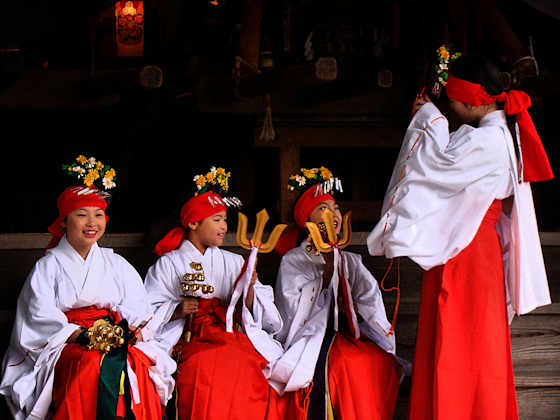
Miko-mai, or Miko Kagura


Today was the matsuri at Tsunozu. Last night was the all night kagura, but I was feeling a bit under the weather so didn't make it, but went there today to catch the mikoshi parade and the Miko mai.


Miko-mai is probably the most common and widely seen form of kagura in Japan, though its rare in my neighborhood. Most of the bigger shrines that have full-time staff and miko will perform it.


Here at Tsunozu the miko are 4 young elementary school girls. First the dance was performed inside the shrine at a ceremony for all the "leaders" of the village and matsuri. Later it was performed outside the shrine for all the assembled villagers.


Tsunozu really takes their matsuri seriously, with all the local kids getting the afternoon off school.


Unfortunately this year, just as the procession was beginning the heavens opened up and we were drenched in a downpour.


Sunday, November 1, 2009

Cave of 1000 Buddhas

sh9977

The Cave of 1,000 Buddhas is another of the "attractions" at Kosan-Ji on Ikuchijima in Hiroshima Prefecture.

sh9979

One descends into a labyrinth of underground caves and tunnels past a series of tableaux and depictions of buddhist hells.

sh9982

Then one enters the realm of the buddhas.

sh9983

The caves and tunnels are all man-made.

sh9976

One emerges back into the light at the foot of a giant statue of Kannon.

sh9956

Saturday, October 24, 2009

My Sky Hole.85

hiro2651

My Sky Hole.85 is a large public sculpture by world-renowned Japanese artist Inoue Bukichi.

hiro2653

It's one of a large sequence of works titled, not unsurprisingly, My Sky Hole. This one was completed in 1985

hiro2654

It's located outside of the Wel City building in Hiroshima, a few hundred metres from the Peace Park.

hiro2655

He was born in Nara in 1930, and died in 1997. There is another of his works in Hiroshima.

hiro2658

Friday, October 16, 2009

The Heights of Eternal Hope for the Future

sh9998

Miraishin no Oka is a 5,000 sq. m. sculpture park on the hilltop overlooking Kosan-Ji on Ikujima, a small island in the Inland Sea off Hiroshima.

sh9992

The brainchild of Environmental sculptor Kazuto Kuetani, all the sculptures and the marble that coveres the hillside was shipped from the Carrera quarry in Italy, where he has worked for the past 18 years.

sh9990

The only way to visit the hill is through Kosan-Ji, which charges 1,200 yen entrance, but what you get for that price is quite astounding.

sh9993

On a sunny day the hilltop is blinding. There is also an Italian restaurant in the park.

sh9999

The island can be reached easily from Ehime Prefecture in Shikoku or Ohnomichi Town in Hiroshima.

sh9997