Showing posts with label tsunozu. Show all posts

Thursday, July 2, 2026

Kakinomoto Shrine & Tsunozu Otoshi Shrine


Kakinomoto Hitomaro is the greatest of the ancient poets and is worshipped as the kami of poetry.


He was a low-ranked bureaucrat from Yamato who was posted here as acting governor around the end of the 7th century. He maried a Tsunozu  girl known now as Yosomi no Otome. Whereas Kakinomoto is considered the most prominent of the poets in the Manyoshu, Yosomi was the female poet with the most entries in that anthology.


There is actually very little known for sure about Kakinomoto. One historian I like  suggests that being sent to Iwami was an exile for being on the wrong side of a succession dispute at court. He suggests that he was poisoned while here and as it was a political murder Kakinomoto was elevated after death to placate his angry ghost.


There used to be a huge, old pine tree here but it was cut down not too long ago for safety reasons. A cross section of the trunk is on display inside one of the shrne buildings. Masuda, down the coast aways, claims to be where Kakinomoto died. There are several of his poems that have been inferred to have been wriyyen about the Gotsu area, including one spot just downriver from my place. Kakinomoto and Yosomi are mascots for Gotsu.


From here it is just a short walk to the main shrine of Tsunozu, yet another Otoshi Shrine.


I have been here quite a few times for their annual matsuri parade. A video and photos of the Miko Mai dance is here. I met the priest soon after moving to Shimane, and am still using the desk he gave me.


In front of the shrine are a couple of small Buddhist altars with colourful statues. They are part of a miniature 88 "temple" pilgrimage around the town and hills.


According to the shrine records it was established in the late 9th century. It moved to its current location in 1711. It is one of the half dozen Otoshi shrines in the region that might be the one listed in the Engi Shiki.


An ancient ritual called Yatate that dates to the time of looking out for signs of Mongol invasion. Samurai would shoot an arrow at a target on a pine tree at the entrance to the shrine. The ritual was discontinued in the Meiji Period.


Sunsiduary shrines in the grounds are Kotohira Shrine, Omoto Shrine, and Itsukushima Shrine.


Like most shrines in the Gotsu area, but not inland in the mountains, there is a Kaguraden. All-night kagura takes place on October 31st and mikoshi parades and miko mai on November 1st. Kids get the day off school.


If you would like to subscribe by email, just leave your email address in the comments below. It will not be published or made public. I post new content almost every day, and send out an email about twice a month with short descriptions and links to the last ten posts.


Monday, November 2, 2009

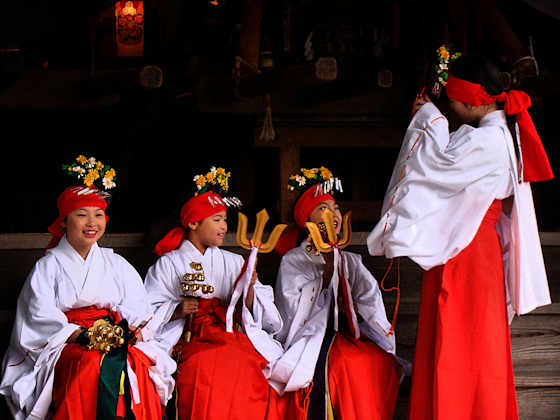
Miko-mai, or Miko Kagura


Today was the matsuri at Tsunozu. Last night was the all night kagura, but I was feeling a bit under the weather so didn't make it, but went there today to catch the mikoshi parade and the Miko mai.


Miko-mai is probably the most common and widely seen form of kagura in Japan, though its rare in my neighborhood. Most of the bigger shrines that have full-time staff and miko will perform it.


Here at Tsunozu the miko are 4 young elementary school girls. First the dance was performed inside the shrine at a ceremony for all the "leaders" of the village and matsuri. Later it was performed outside the shrine for all the assembled villagers.


Tsunozu really takes their matsuri seriously, with all the local kids getting the afternoon off school.


Unfortunately this year, just as the procession was beginning the heavens opened up and we were drenched in a downpour.


Sunday, October 19, 2008

Tengu Mask

tengu

The earliest form of Tengu in Japan was a half-bird half-man creature, the Karasu (crow) Tengu, but the commonest form is the red faced, long nosed version that has come to be associated with yamabushi, the "mountain warriors" of Shugendo. Like all the masks, it is often used to ward off evil spirits. Like all my masks, this one is for sale at a very reasonable price :).

One weekend one year ago 1573

I've only seen the Tengu mask used in one kagura dance, and I've only seen it performed once.

One day on Miyajima 4559

This wonderful carved mask is in the temple on top of the mountain on Miyajima.

oku10

Another carved wooden mask, this one was over a metre in height, so obviously not meant to be worn. It seems the mouth is made to move. It was at a shrine in Miyoshi.

dai73

The tengu with it's huge nose is an obvious phallic symbol. This was one of a pair of masks guarding a "vagina" rock at a fertility shrine on Mt. daisen.

mats13

A tengu leads the procession at Tsunozu Matsuri

Kagura mask index

Wednesday, September 24, 2008

Tsunozu Otoshi Shrine

mats1

Tsunozu's Otoshi shrine is in the old part of the village where a maze of alleys and narrow roads and traditional houses are still maintained. Most villages have old sections like this.

It's matsuri day, so the streets are lined with shimenawa, fresh bamboo, and shrine banners. The shimenawa lining the streets are to protect from evil as the kami will be passing by later in the matsuri procession.

mats3

At the shrine the flags are out in celebration of the matsuri, which occurs after the harvest in early November. As well as the main kami, Otoshi, there are secondary shrines to Inari (Otoshi's brother), Omoto, the local land kami, and konpira.

mats5

The mikoshi stand ready to be carried through the village later. While I was visiting the shrine the ceremonies were underway to transfer the kami into the mikoshi.

mats7

One of the 2 komainu (Korean Lions) flanking the steps up to the shrine. These are a fairly standard modern design.

mats25

Mr Kono is the priest of the shrine. He is also responsible for 9 other shrines in the area, but even so his duties do not pay enough to make a living. Buddhist priests have the VERY lucrative funeral business to pay their wages, but other than at major shrines, most Shinto priests must work at a regular job.

Saturday, September 13, 2008

Matsuri procession

mats19

The annual matsuri for a shrine will usually include a procession. The details differ a little from shrine to shrine, but the format is basically the same. This procession is being led by a Tengu, a kind of forest goblin commonly associated with yamabushi.

mats20

Next up is a Shishi, chinese lion. This was the first time I'd seen one in a procession.

mats18

The taiko is normally carried suspended from a stout piece of bamboo by 2 men, but this was pulled in a purpose-built taiko cart. I was particularly impressed with the seatbelt that the drummer is wearing.

mats17

The children's mikoshi comes next. The kids get half a day off from school for the matsuri.

mats10

Next come the larger and heavier mikoshi(s) carried by the village men, and occasionally women. Nowadays, if the village is large and the population dwindled, the mikoshi sometimes are carried by small pick-up truck.

mats22

After the mikoshi come the priests and shrine assistants, followed by the Miko who earlier danced for the kami.

mats29

Sometimes the mikoshis will stay at different spots around the village so that further ceremonies may take place.

All these photos are from the Tsunozu matsuri held in the local Otoshi shrine in the first few days of November.