Friday, June 27, 2025

Ako Oishi Shrine


Ako Oishi Shrine is located within the grounds of Ako Castle.


It is very much what I would consider a political shrine and was not built until 1912, though permission was granted in 1900 but right-wing nationalists were opposed to it.


It is known for the statues of the 47 Ronin lining the approach and was named Oishi Shrine after the leader of the group.


In the late 1940's a shrine enshrining the former daimyo of the castle was built nearby named Ako Shrine.


In 2000, the two shrines were merged together.


There are numerous secondary shrines in the grounds including an Inari, Awashima, Ebisu, Tenmangu, and a Hatta Shrine.


There are also statues of the 12 zodiac animals.


Notable are the komainu statues which are somewhat unusual.


I am not exactly sure of the story, but the shrine has some association with dogs, and visitors are allowed to bring dogs with them into the shrine.


I was wondering why therevwere such cute teddy bear ema votive tablets, before realizing that they are in fact dogs.


The shrine is built on the site of Oishi Kusunoke's residence, and the gatehouse still stands as well as a small garden.


There is a treasure house with swords and other artifacts connected to the 47 ronin.


The previous ost in the series was on nearby Fumonji Temple and its delightful Kannon statue.


Wednesday, June 25, 2025

Senkoji Temple Icon of Onomichi


Senkoji, temple number 10 on the Chugoku Kannon Pilgrimage is located on the mountainside overlooking the historic town and port of Onomichi.


On this trip I visited by taking the ropeway to the top of the mountain and then walking down to the temple. These first two shots were taken from the cablecar on the way up.


The views from above the temple are stupendous...


I have visited Senkoji several times before, so on this visit I passed through pretty quickly and didn't take so many photos.


The temple was founded in 806, with some saying by Kobo Daishi himself.


The temple was restored in the 10th century by Minamoto Mitsunaka.


The temple is about 140 meters up the mountain so the views are still quite magnificent.


The current main hall dates to 1686


There are numerous large rock outcroppings around the temple, the biggest being known as Tamanoiwa


The honzon is a Thousand-armed Kannon. It is a secret Buddha only shown to the public once every 33 years.


However a replica stand-in is in front of the altar ( 2 photos below)


The previous post in this series on day 11 of my Chugoku Kannon Pilgrimage walk was on Saigokuji Temple, the biggest temple in Onomichi.


Not far below Senkoji on the temple walk route is the Tenneiji Pagoda, a classic photo spot.


Tuesday, June 24, 2025

Chozenji Temple 8 Shikoku Fudo Myoo Pilgrimage


Chozenji Temple is number 8 on the Shikoku Fudo Myoo Pilgrimage.


It is located a few kilometers downstream from temple 7, Fukushoji. Each of the 36 temples on the Fudo Myoo Pilgrimage has one of the 36 doji, child-attendants of Fudo. At the foot of the stairs above is Shitara Doji.


Like Fukushoji, Chozenji seems like a pretty unremarkable rural temple.


However, it claims to have been founded by Kobo Daishi himself and if I am reading the history correctly, was a fairly major temple.


The Fudo enshrined here is said to be a Fudo who shows miraculous powers for warding off swellings and rashes and has become known as a Fudo to ward off cancer.


From the main hall further steps lead further up the mountainside through a "tunnel" of red torii.


This leads to Mogami Inari Shrine, a branch of Saijo Inari, a Buddhist temple in Okayama.


I can find no information on when the shrine was established or anything about it.


The main building seems to be fairly recent and has some nice ceiling paintings.


It has a pair of Tengu masks hanging on tye front of the building and a pair of what looks like Nio masks but could be other characters...


The steps continue on up to the temple Okunoin, a man made cave with a large painting of Fudo and water streaming from a hole in the ceiling.


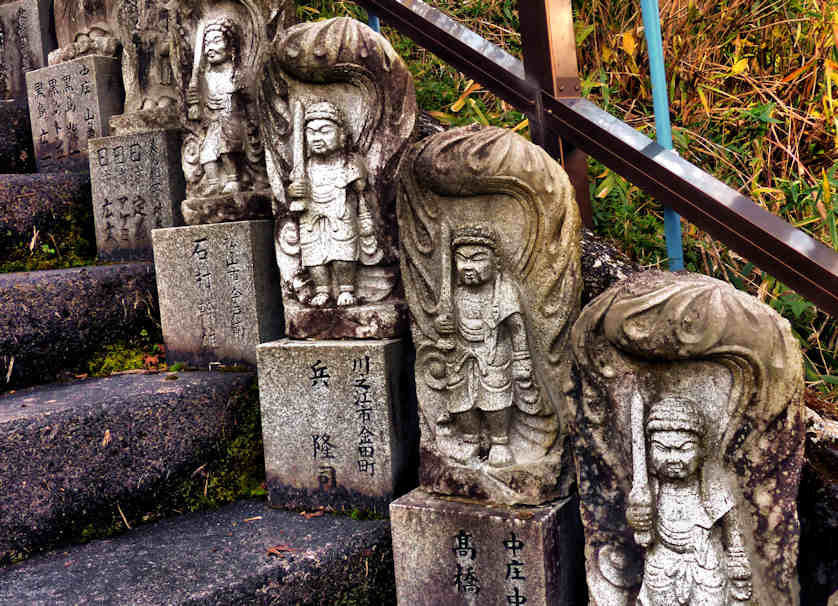
The stairs leading up are lined with Fudo statues on the right side and another figure on te left. This may be Kukuzo, the honzon of the temple.


The temple burned down in 1586 and was rebuilt in 1588. In 1598 it was name Ekiji.


It is said to have consisted of seven structures, including a pagoda. It burned down again in 1864 and was rebuilt in 1890.


As part of the Spring Fudo Myoo Festival, firewalking by Yamabushi takes place in front of the Okunoin.


A couple of paintings from the temple are National Important Cultural Properties and are held by museums in Kyoto and Nara.


The previous post in the series was on the previous temple, Fukushoji, number 7.