Mount Taima, 599 meters above sea level, is the highest mountain on the coast between Hamada and Misumi in Shimane.
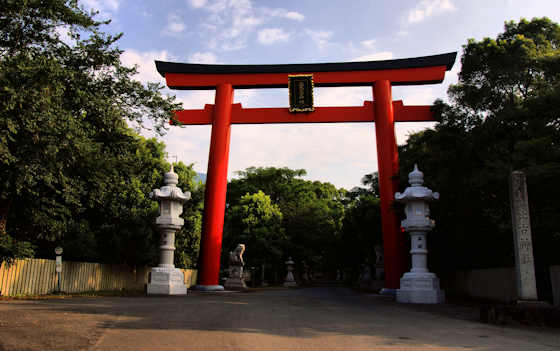
About halfway up the narrow mountain road from the sea to the shrine close to the top of the mountain, a giant torii straddles the road.
The miuntain was originally named Futagoyama, but the name was changed by imperial decree in 888 following a "divine revelation". I cant find out anuthing about the revelation except that since the start of the 8th century monks had been living on the mountain. In 889 the kami from
Oasahiko Shrine in Tokushima was transferred here and the branch shrine established.
Oasahiko Shrine was originally established by the Imbe Clan, sent to Shikoku to find good land for growing hemp. The hemp plant motif is all over the shrine here at Taimasan, but cannot be seen at
Oasahiko Shrine.
There is a local legend of the Imbe Clan moving into the area of Mount Taima and driving out the Ono Clan. According to the story they moved down the coast to the mountain where Susa is in Yamaguchi, the next landmark high mountain down the coast. On the slopes of Mount Taima is an area of large boulders. They were thrown here by a giant on the mountain near Susa. According to the legend, an agreement was reached between the Imbe and the Ono and they returned to the area, but the Imbe kept Mount Taima. One source suggests that the Yamato sent the Imbe into Iwami to help contain Izumo.
The original kami of the shrine were Oasahiko, Sarutahiko, Amahiwashi, and Zao Gongen.
Several temples were established around the shrine and in the mid 10th century another series of kami were enshrined here; Kumano Gongen, Sanno Gongen, Hakusan Gongen, and Hashiryu Gongen. As can be inferred by this list, Taimasan became a major Shugendo site.
In the early 16th century the shrine-temple complex was destroyed during the war between the Amago and Ouchi clans. It was rebuilt, and a scroll painting dated to the late 16th century depicts it as a very large complex of shrines and temples with the nickname of Koyasan of the West, a nickname it shared with numerous other sites in western Japan.
In 1836, a major landslide destroyed the shrine and temple, and only the shrine was rebuilt in 1844, along with part of the temple.
In 1872, everything was again destroyed, this time by the Hamada Earthquake. Due to the anti-Buddhist movement, only the shrine was rebuilt.
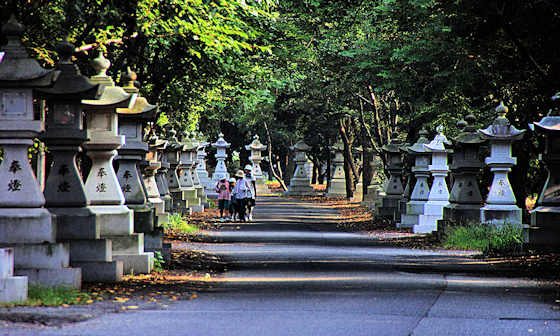
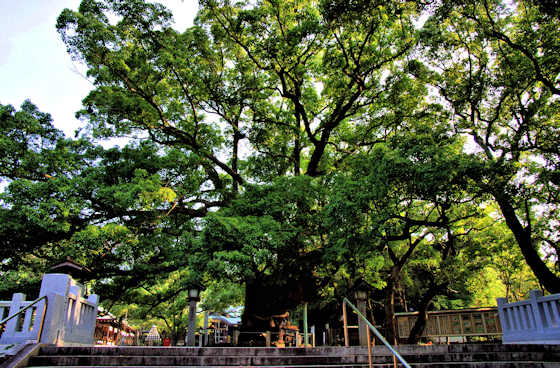
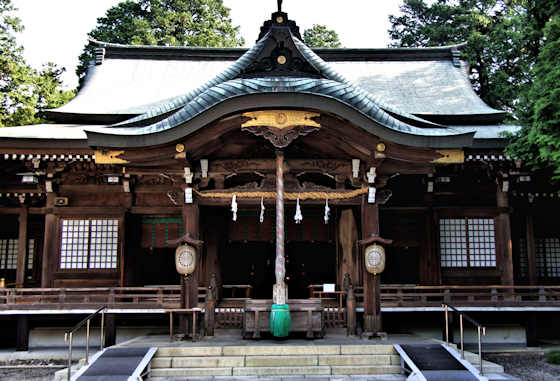
Today, the shrine stands alone in the middle of the forest. The old temple garden has been restored and is well worth a visit. On the top of the mountain among all the antennae is an observation tower with fantasticviews.... I will cover that next
Hemp has a long and glorious history in Japan, though since it was banned by MacArthur in 1948 it has become very demonized and many Japanese have no idea of its history.
It has been cultivated here long before the Yamato immigrated here. Its main use was its fibre used for many products but mainly for clothing.
It continues to be used for some Shinto implements and there are dozens of small, licensed farms that legally produce it for this purpose,including use by the Emperor.
It is also used in a herb and spice mix called shichimi. One of my favorite Japanese patterns found on many fabrics and other products is Asa no Ha, a hexagonal pattern associated with good luck.
I have been unable to find out anything about hemp production in the area around Mount Taima, but since the region was not so well suited for rice production, I would think there would have been a lot of it.
After the introduction of cotton in the late 19th century, hemp production declined somewhat, but it remained an important crop, especially during the war.
If you would like to subscribe by email just leave your email address in the comments below. It will not be published and made public. I post new content almost everyday, and send out an email about twice a month with short descriptions and links to the last ten posts




 Posts
Posts


