Showing posts with label sukunahikona. Show all posts

Wednesday, October 21, 2026

Ogamiyama Shrine


Ogamiyama Shrine has a long and somewhat unusual history. It is mentioned in the Izumo Fudoki, and is listed in the Engi Shiki, and is the Ninomiya, second-ranked shrine, of Hoki Province.


Mount Daisen has long been a sacred mountain, and the shrine's origins lie in a small shrine built high up on the mountain by ascetic monks.


As the mountain was covered in deep snow during the winter, a second shrine, this shrine, was built down below so people could worship in the winter. The top shrine became known as the summer shrine and this one was the winter shrine.


The kami enshrined here is Okuninushi. In ancient times, when the Fudoki were written, Okuninushi was considered to reside in/on Mount Daisen. All the stories of Okuninushi come from what is now Tottori, and at the northern base of Daisen is a Yayoi settlement that was one of the biggest in all of Japan, a strong possibility for the capital of an Izumo Polity that ceded the country to the Yamato.


As the mountain shifted to a more Buddhist-oriented mountain worship, the main deity of the mountain became Jizo.


The mountain was a huge shugendo centre with at one point 189 sub-temples and a community of 3,000 "warrior monks". The most famous warrior monk was Benkei, and there are stories that he spent time on Daisen.


The current shrine buildings date to the mid-Edo period. The grounds have 1,000 Hydrangea bushes, and this is one of the top hydrangea spots in Tottori.


The Tottori Association of Shrines says that along with Okuninushi, also enshrined here is Oyamatsumi, Susano, & Sukunahikona.


Secondary shrines in the grounds include a Misaki Shrine enshrining Amaterasu and two other kami.


In 1868 with the separation of Buddhas and Kami, Jizo was removed from the shrine at 900m, the summer shrine, and it became the Okumiya, inner shrine; this shrine, the winter shrine, became the main shrine.


Flanked by two foxes is the "worship from afar" shrine, enabling those unable to climb the mountain to the inner shrine to worship from afar.


As well as the hydrangeas, the large shrine grounds also includes one of the biggest Iris gardens in the San-in region.


The previous post in this series on my walk along the Chugoku Kannon Pilgrimage was on the walk into Tottori that ended the previous day.


If you would like to subscribe by email, just leave your email address in the comments below. It will not be published or made public. I post new content almost every day, and send out an email about twice a month with short descriptions and links to the last ten posts.


Tuesday, September 15, 2026

Saka Shrine Origin of Sake in Japan

Sake - Nihonshu

Down below Ichibata Yakushi Temple, and not far from Ichibataguchi Station, is Saka Shrine, sometimes called Matsuo Shrine.


October 2nd, 2015, and this is where I start day 43 of my walk along the Chugoku Kannon Pilgrimage.


This is an ancient shrine connected to the production of Sake, and the areas around it all have names connected to sake.


The first time sake is mentioned in the ancient myth-histories published in the early 8th century is when Susanoo brews some sake to give to the Orochi serpent, which he then slays when they are in a drunken stupor. As sake is a word used for alcohol in general, it is suggested that the sake he brewed was made from fruit.


However, same books, plus the  Izumo Fudoki, published a few years later, has a legend from this area wherein 180 kami gathered together, built a kitchen and brewed up some sake, and had a 180-day feast.


About ten kilometers away up the Hi River is Mankusen Shrine, where a big group of kami gathers during Kamiarizuki, the annual meeting of almost all of Japan's kami in the Izumo area. The shrine has a unique ritual and ceremony wherein the kami are kind of pushed out of the shrine because they won't leave. The reason they won't leave is that they say the sake here is so good.


The primary kami of Saka Shrine is Kushinokami, believed to be another name for Sukunahikona, the sidekick of Okuninushi who settled and created the land of Izumo. He was also linked with medicine. Also enshrined here are 180 unnamed kami, obviously a nod to the myth-legend.


At some point before the 16th century, the kami of Matsuo Shrine near Kyoto was enshrined here. Oyamakui is also considered the kami of sake, and Matsuo Shrine in Kyoto is considered the main sake-brewers' shrine in Japan. Saka Shrine was known as Matsuo Shrine until the Meiji Period, when it reverted to Saka Shrine.


Researchers and historians believe that sake was introduced into Japan from Korea via Izumo. The Hata Clan created the Matsuo Shrine in Kyoto, and the Hata are known to be an immigrant clan from the mainland; some say China, some say Korea, some say even further west. Many historians suggest that the Hata spent some time in Izumo before moving on to Yamato. All this suggests that the area around Saka Shrine may well be the origin of Sake in Japan...


Sake brewers continue to support and pray at Saka Shrine. At the annual festival in mid October, at which the head priest has brewed sake for it, many sake brewers gather. The shrine has a special license to brew the sake.


In the grounds are numerous secondary shrines, notably an Inari.


There are also an Ekisha, a Takeuchi Shrine, and a Hoden Shrine. The most interesting is a Smallpox Vaccination Shrine.


The previous post in this series was on the 84,000 Yakushi statues at Ichibata Yakushi. Well worth a look!


If you would like to subscribe by email, just leave your email address in the comments below. It will not be published or made public. I post new content almost every day, and send out an email about twice a month with short descriptions and links to the last ten posts

Japan sandals

Sunday, October 27, 2024

Shizuma Shrine & Shizunoiwaya Cave


Shizuma Shrine is on a small road close to the coast in Shizuma near Oda in Shimane.


In earlier times it was located inside a nearby sea cave, but a storm in 1674 changed the topography of the cave and so the shrine was moved to its current location.


It was founded in the 9th century and enshrines Okuninushi and Sukunahikona and is based on a poem in the second volume of the Manyoshu.


The poem mentions a stone chamber used as a temporary dwelling by Okuninushi and Sukunahiko while they were "creating" the land.


However, a couple of other sites also lay claim to being the "stone chamber", one a shrine in the mountains upriver from me, and the other a place in Hyogo. As all the Okuninushi and Sukunahikona stories are set in the Shimane and Tottori regions, the Hyogo claim seems suspect.


A monument inside the cave memorializes the Manyoshu poem.


The cave has two entrances, although now they are roped off and no-one can enter because of the danger of falling rocks.


The cave is on the beach right next to the small fishing village of Uozu, just west of the mouth of the Shizuma River.


I visited at the start of the fifth day of my deep exploration of the coast of the Sea of Japan. The previous post was on Isotake Beach where I ended the 4th day.


Monday, November 6, 2023

Obama Shrine & its Komainu


Obama Shrine is the main shrine of the small, coastal hot spring resort of Obama on Tachibana Bay in Nagasaki.


The current shrine building was constructed in 1995 on the site of the former Kengara Shrine when Obama Shrine and Kengara Shrine were combined.


It seems the original Kengara Shrine was built in 1679 at the same time the nearby Obama Shrine was rebuilt. At that time both shrines had different names.


The kami enshrined here are Okuninushi, and Sukunahikona who is often portrayed as a sidekick of Okuninushi. Sukunahikona is sometimes considered a god of hot springs due to an episode in the ancient myths set at Dogo onsen in Shikoku. The other kami enshrined is Takemikazuchi.


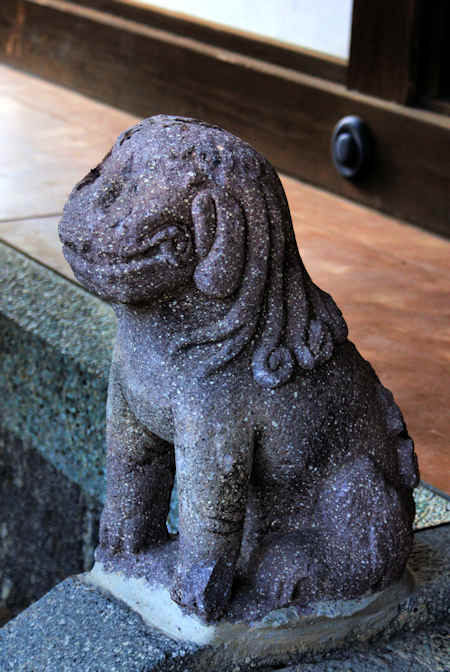
The main building has a ceiling painting of a dragon which was transferred from the older shrine, but, for me, the most interesting thing at the shrine was the two pairs of small komainu that I suspect came from the two older shrines.


The previous post was on the longest hot spring foot bath in Japan which is nearby.


Saturday, July 18, 2015

Tamatsukuriyu Shrine


The main shrine in Tamatsukuri is the Tamatsukuriyu Shrine. The three main kami are Kushiakarutami, Onamuchi (Okuninushi), & Sukunahikona. The latter two are well known, but this was my first encounter with Kushiakarutami, who was the priest Tamasuri (he who makes the jewels) who enshrined Okuninushi following the ceding of the land to the Yamato, Kuniyuzuri.


Kushiakarutami is also equated with Haakarutama and Amenoakarutama, the first being the kami that gave Susano the jewels he used in his "contest" with Amaterasu, and the second being the kami that produced the jewels that were hung outside the cave that Amaterasu used to hide away in. The common feature of all these kami is the production of "jewels", the comma- shaped stones known as magatama. Tamatsukuri was a center of magatama production and the unusually shaped treasure house of the shrine has many of the objects found in archeological digs in the shrine area.


Nowadays the shrine is most well known for its "wish fulfilling stone" (negai ishi). Nowadays you can buy small stones from the shrine office and hold them against the almost spherical stone and have its power transferred.


There are numerous secondary shrines within the grounds including an Inari, Konpira, Susa, a Tama no Miya, Several other shrines I can find no information about, Kikakashi, Fukutoku, & Sanatama.