Showing posts with label kakinomoto hitomaro. Show all posts

Thursday, October 30, 2025

Nishoyamada Shrine


Nishoyamada Shrine, located next to Kanyoji Temple, the next temple on the Chugoku Pilgrimage for me, has a delightful, long approach with plenty of Autumn colours....


The shrine was created in 1907 by the merging of two shrines,  Nisho Daimyojin and Yamada Gonzensha


This was at the peak of the governments program to drastically reduce the number of shrines in the country.


Other shrines in the grounds that were moved here around the same time is a large shrine to Sugawara Michizane, commonly referred to as Tenjin. There is aaslo a small Kibune Shrine and a Gokoku Shrine, the local version of Yasukuni, the modern shrine enshrining war dead.


The Nisho Shrine was established in 899. moved in 1262, and then moved to its current location in 1674.


The primary kami are Omononushi and Yachihoko, which is curious as they are both aliases of Okuninushi.


Secondary kami associated with the former Nisho Shrine are Sukunahikona, Susano, Kagutsuchi, Kotoshironushi, Ichikishimahime, and Kakinomoto Hitomaro. Most are considered the Izumo pantheon, though Kakinomoto is a curiosity.


Yamada Shrine was established in 1292, but a theory is that it existed much earlier as a clan shrine and in the 13th century was made a branch of Ise Shrines.


The primary kami are Amaterasu and Toyoke.


The secondary kami are Amenokoyane, Ukemochi, and Sarutahiko. Okuninushi and Susano are also listed as secondary kami of the former Yamada Shrine.


In 1906 the head priest started manufacturing omikuji as a source of income and now the company produces 70% of all omikuji in Japan. They also invented the machines for dispensing omikuji at unmanned shrines. Omikuji were originally something developed in Tendai temples connected with Kannon, and during the Edo Period spread by Yin Yang diviners. Shrines started to promote them around the early 20th century


The shrine is located in Shunan City, Yamaguchi, though actually it is quite a remote area in the mountains about 25k north of Tokuyama.


It is close to the expressway, and there is an infrequent bus from Tokuyama that comes to the temple next door.


if you would like to subscribe by email, just leave your email address in the comments below. It will not be published or made public. I post new content almost every day, and send out an email about twice a month with short descriptions and links to the most recent posts.

Monday, March 6, 2023

Around the Next Bend

Around the Next Bend


This is the 5th post in my new series that explores the Gonokawa River, the longest in West Japan, as I walk up the right bank to the source almost 200 kilometers away.


On the opposite bank on the inside of the first big bend in the river is a still operating quarry that produces aggregate for concrete. This bank is far less inhabited but had a rail line that closed down a few years ago. I am interested to see how the depopulation of the countryside is affecting things....


For a while, the road clings to the narrow strip of land between the mountain slope and the water, made just wide enough for the road plus the rusting rails of the defunct railway.


And then we come to Chigane a tiny settlement in a small valley with maybe half a dozen houses. This used to be the next station on the rail line after Gotsu Honmachi, though in all my journeys on the train I never once saw anyone get on or off here. 20 years ago when I first moved to the area I joined a free Japanese language class run by the city. All of the other students were young Indonesian women who had married local men, one of them the oldest son of a farm family here in Chigane.


Though there were no fresh flowers, the roadside altars had been swept and kept clean.


At the next big horseshoe bend in the river, a sign points to a spot on the bank. On the other bank is a similar sign. They mark a spot on the river that is said to have been memorialized by the greatest of Japan's ancient poets, Hitomaro Kakinomoto. In the Manyoshu, the oldest book of Japanese poetry dating back to the 8th century, Hitomaro has the most poems. One of his wives was a woman from this area, and there are several spots around the area that commemorate places mentioned in their poems.


As I understand it, from this point on the river ceases to be tidal.


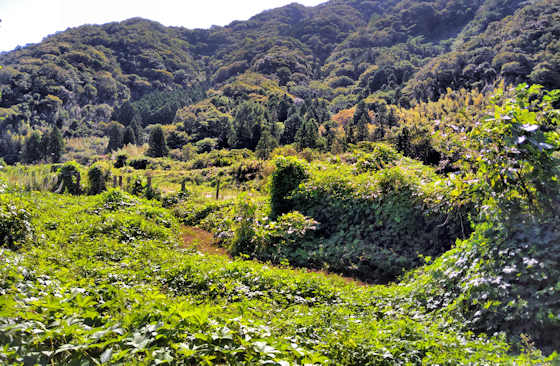
The next settlement is Tanomura, has large swathes of what was once rice paddies and fields that have now become swallowed up by Kudzu In the trees in the middle of the above photo are several quite large farmhouses, now abandoned.


The previous post in the series is Zenkakuji Temple.

Sunday, February 23, 2014

Torii Tunnels


nag5261

Lines of red torii placed so close together they form a tunnel are a common sight throughout Japan. The most famous and most photographed are at the Fushimi Inari Shrine near Kyoto, but smaller versions can be found all over at shrines and temples.

tad2377

They are usually made of wood, occasionally steel, but more often nowadays plastic pipe is being used. Each torii will have been paid for by a donation, and the name of the donor is usually written on each, similar to how some shrines will have lines of more expensive stone lanterns.

kok559

The top photo is from the Inari Shrine in the grounds of Suwa Shrine, Nagasaki. The second photo is at Tadaji Temple in Hamada. The third is a small Inari hokora near Kokura Castle.

mas2960

The photo above is an Inari shrine in the grounds of the Hitomaro Shrine in Masuda.

tsu927

If the Inari shrine is on a hillside, like at Fushimi, then the torii tunnels will switchback up the hillside like the photo above taken at the Taikodani Inari Shrine in Tsuwano.

Saturday, June 11, 2011

Manhole Fruit

Manhole Fruit

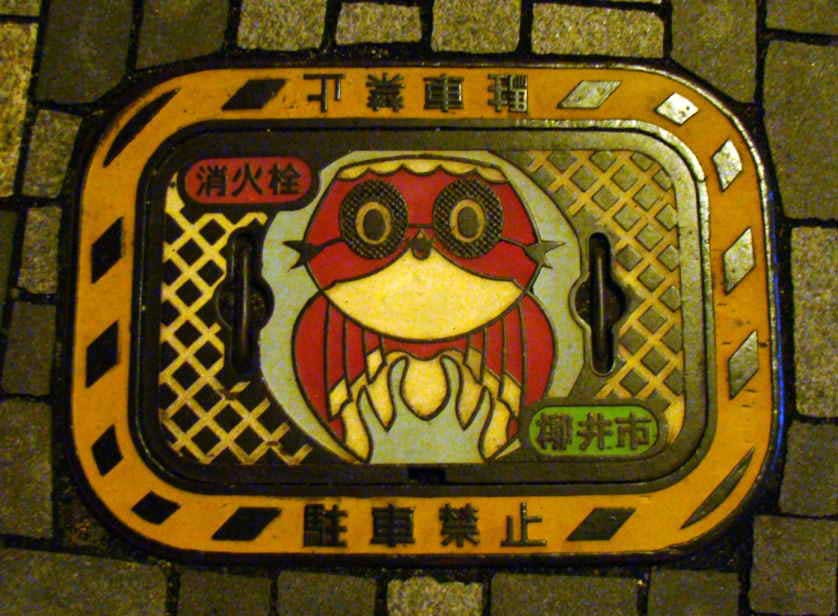
Manhole Fruit.

Found this one outside of Yanai in Yamaguchi Prefecture. Not sure which fruit it is other than a citrus.

Mito Town down in the west of Shimane is known for its Yuzu, a member of the citrus family that ripens in December.

Asahi Town is up in the mountains a few miles away from my village. They are known for their Nashi, Japanese pears. Much tastier than the pears we have in Europe.

Higashi Izumo seems to favor Kaki, persimmons.

Omishima, a small island in the Inland Sea, part of Ehime grows a lot of different citrus. Not sure which one this is meant to be.

Saturday, April 4, 2009

Meteor, Mountain, Manyoshu.

star3435

Bristling with towers and antennae, the 470m high Shimanohoshitakayama, hereafter known as Star Mountain, is visible from up and down the coast and from Rte 9 or the train as one passes through Gotsu.

star3443

The star on the mountainside, most visible after a snow or when lit up in August, symbolizes a meteor that slammed into the mountain in the year 874. At the site of the impact a temple was built. Reisyo-ji, and the meteor itself enshrined as Inseki Daimyojin, which could be translated as Meteor Great Shining Deity.

star3444

The space in the door of the little shrine is so you can reach in and touch the meteor. It is a decent size... I haven't been able to find out its weight, but it's close to a metre in length.
The crater made by its impact is now a small pond just in front of the temple.

star3447

The small temple itself is fairly nondescript, but outside there are several large statues of Kannon.

star3440

Like most temples or shrines that have a strong "folk" tradition, there are an interesting, eclectic, collection of little statues of assorted kami, buddhas, and saints.

star3438

Right next to the temple is a park with over 500 Camellia trees. Also nearby is a miniature golf course, and the local "Clean Center" which is where the trash gets recycled and incinerated. Only in Japan could a place that produces toxic dioxin be called a clean center!

star3448

There are several spots with scenic overviews of the coast and beautiful downtown Gotsu below.

There is a small settlement up here too, though I was surprised to learn that people didn't move on to the mountain until the 1940's.

17july25

The local shrine is named after Kakinomoto Hitomaro, probably the most well known of the ancient poets whose work is in the Manyoshu, the oldest anthology of Japanese poetry.

It is believed that the mountain is described in one of his famous poems, On Leaving Iwami, and the evidence is strong. The Sanindo, the ancient road linking the region to the capital in kyoto, passes in front of the mountain, and kakinomotos wife is from Tsunozu at the base of the mountain to the west. Actually he had quite a few wives, but Yosami no Otome is the most well known as she was a poet in her own right and her works are also in the Manyoshu. The love story of Kakinomoto and Yosami was made into a childrens picture book and images of the couple appear all over the Gotsu area, looking suitably cute.

This is a follow-up post to an earlier post.