Showing posts with label gingko. Show all posts

Tuesday, December 2, 2025

Ryuzoji Temple 17 Chugoku Kannon Pilgrimage


Ryuzoji Temple, the oldest temple in Yamaguchi City, is the 17th temple on the Chugoku Kannon Pilgrimage and is a little out of town and not easily accessible by public transport so remains somewhat unkown to visitors.


I was totslly blown away by the phenomenal colours of the maple and gingko together...


At the bottom of the steps leading up is the remains of a small garden attributed to Sesshu. It was in poor condition when I was there but I believe it has been somewhat renovated now.


This is another of the temples where I took so many photos that I will break it down into two posts.


The origins of the temple lie in 698 when En no Gyoja, the legendary founder of shugendo, was returning from Hikosan in north Kyushu and discovered the cave on the mountainside that is now the okunoin.


Later, in 741, Gyoki came here, carved a Thousand-armed Kannon and established 7 halls


During the Edo Period ii seems it was a fairly large temple complex.


However, with the anti-Buddhist movements of early Meiji the temple was partially destroyed and abandoned.


In the last years of the 19th century it was revived as a place of worship.


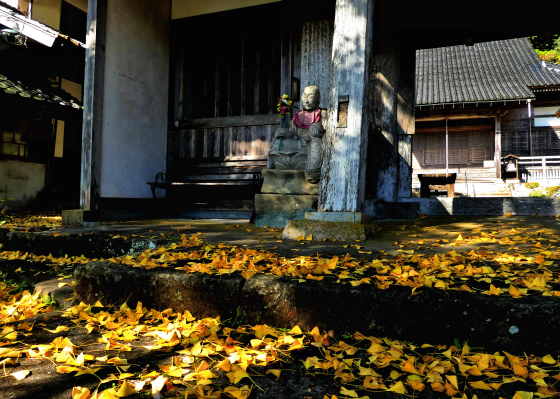
The temple was packed with things to see,... not least the colours of Autumn, mostly on the ground...


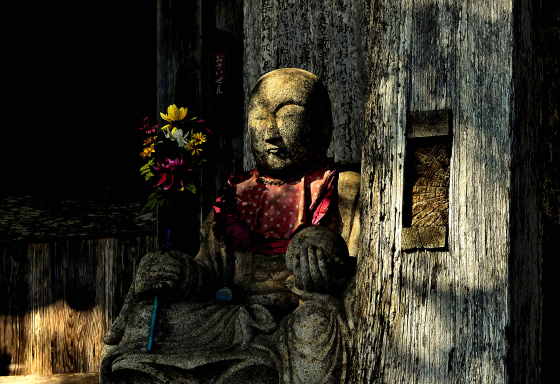
Above is the Basho Jizo. I can find no info on this version of Jizo, so it must be one of the lesser ones...


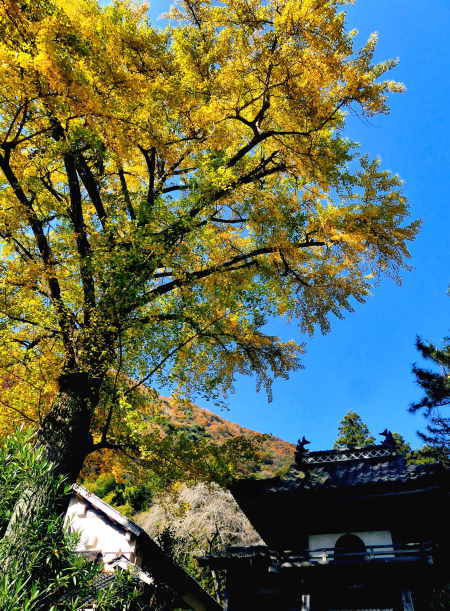
The giant Gingko tree had shed just about all its leaves. It is about 45 meters tall and with a circumference of 12 meters at its base. Its diameters above the ground is 6 meters.


It is estimated to about  550 years old . Of all the nationally registered gingko tree this one is the second tallest and oldest.


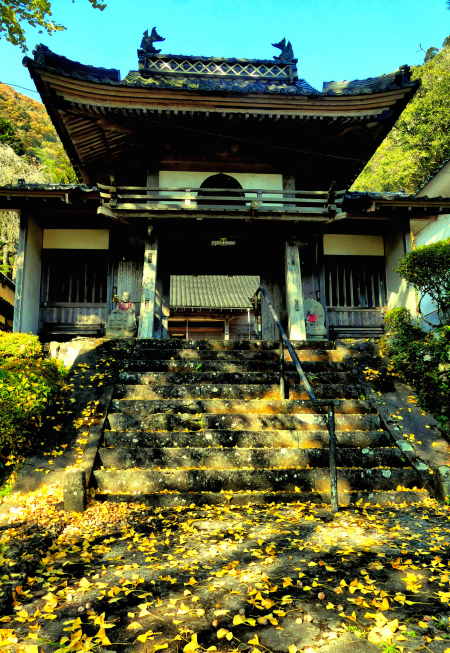
At the top of the stairs, the first building is the Kannon Hall.


The main hall houses the honzon, and Amida. This is a Shingon temple...


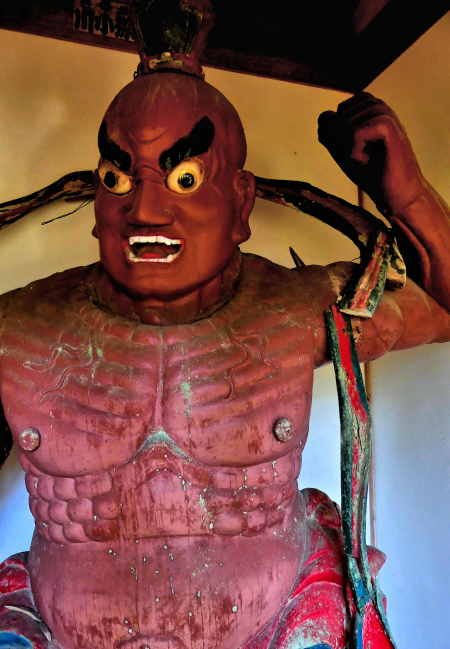
The Kannon is a Bato Kannon, a Horsehead Kannon, and I was very surprised because I would have said it was an Aizen Myoo statue...


Just when you think you have gotten a handle on the identities and multiple appearances of the Buddhist deities, you come across something that blows it all up,,,


The Gingko tree at Ryuzoji Temple is a National Natural Monument.


It seems Bato Kannon can be an "angry" manifestation of Kannon, and "he" is included in the Hachidai Myoo grouping.


May be a Ryuzu Kannon, though usually she is depicted on a dragon, not with a dragon on her head...


In the next post I will cover the large Fudo Myoo, the waterfall, and numerous other sights above and behind the main hall.


The previous post in this series on day 23 walking along the Chugoku Kannon Pilgrimage, was on Rurikoji Temple and its pagoda,  a few kilometers further north.


if you would like to subscribe by email, just leave your email address in the comments below. It will not be published or made public. I post new content almost every day, and send out an email about twice a month with short descriptions and links to the most recent posts

Sunday, December 8, 2024

Chokoji Temple 10 Iwami Kannon Pilgrimage


Chokoji is a Soto sect Zen temple in a remote area of Iwami that has a deep connection with the Iwami Ogasawara Clan.


The temple was founded in the 14th century and seems to have been originally a site founded by the clan as a spot for samurai to recover from wounds. A wooden pillow held by the temple was a gift from Ashikaga Yoshitane to Ogasawara Nagataka for his help in the Battle of Kyoto in 1508


The Ogasawara were not a big clan but were given the domain to protect the Iwami coast following the Mngol Invasions. As the Warring States Period increased the power of the nearby Amago and Ouchi Clans the Ogasawara switched allegiances several times and eventually submitted to the Mori.


Chokoji was the family temple for the clan. The honzon is a Shaka Nyorai, and the Kannon for the pilgrimage is in its own Kannon-do (photo 6).


Nowadays, it is known primarily for the huge Gingko tree in the grounds that creates a golden carpet in late Autumn. I highly recommend this post on the autumn colors here.


The previous post was on the walk to Chokoji from Kannabiji.


Friday, April 14, 2023

Mountain Shrines Autumn Foliage


Route 34 runs roughly East-West along the lower slopes of the southern side of the conically-shaped Kunisaki Peninsula in Oita, Kyushu.


At the end of November, 2012, I was walking along on the 5th, and final, day of my walk exploring the peninsula and was on my way towards the road that heads directly north to the central high point of the area.


Along the way I stopped in at any shrines, temples, or roadside  altars, and as this is an area with a particularly rich religious landscape, there were many of them.


Curiously the first group were all called Yama Shrine, which simply means Mountain Shrine.


A lot of the shrines in the Kunisaki Peninsula are connected to a religious system called Rokugo Manzan which is very much a Buddhist-Shinto hybrid, and so many of the shrines here have Buddhist Nio guardian statues, but this group of shrines did not.


I was also unable to find out anything about any of the shrines.


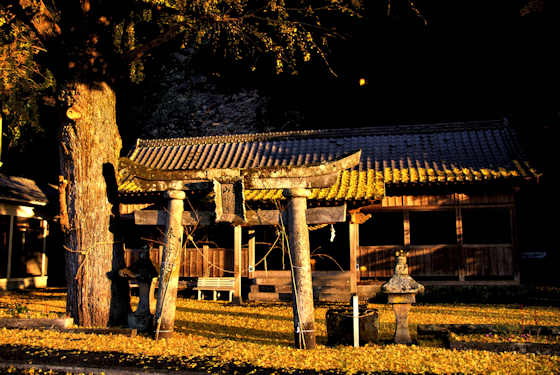
However it was a glorious morning and once the early morning sun penetrated the narrow valley there was a lot of autumn colour, esecially the golden ginko....


The previous post was of the frosty flora I encountered in the shadows....


Friday, December 10, 2021

Kannabiji Temple's Gingko

Kannabiji Temple's Gingko

Kannabiji Temple's Gingko.

It's that time of the year when I post some pics of this year's autumn colors. About three weeks ago Yoko had a day off that coincided with a beautiful sunny day so we headed off on a local trip to see if we could find some color. The first stop was Kannabiji Temple, a few kilometers upstream on the Gonokawa River.

The first stop was Kannabiji Temple, a few kilometers upstream on the Gonokawa River.

Kannabiji moved to its present site at the end of the 19th century. Formerly it was a large monastic complex on the mountainside that dated back to the Heian period.  About twenty years ago a friend took us on a bushwacking hike up to the old site where the foundation stones of the main hall still remained in a small clearing in the forest.

Kannabiji moved to its present site at the end of the 19th century.

At the end of the 16th century, many of the buildings burnt down. I suspect this was part of the Warring States conflicts but have not had that confirmed. The temple continued on its mountain site until the late 19th century. In 1872 a big earthquake closed the spring that supplied the temple with water, and in combination with having much of its land confiscated by the new Meiji government, it was decided to relocate the temple at the foot of the mountain.

At the end of the 16th century, many of the buildings burnt down.

All that remains now is the main hall, a large residence for the priest, a gate, and a large storehouse. I went inside the main hall many years ago and was surprised by a mural on the ceiling and the brightly-painted woodwork. I really want to go back and take a lot of photos. I've also been inside the old priest's house though he now lives in a newer house in front of the temple.

Gingko leaves.

The gate contains a fine pair of Nio guardians and is overshadowed by a large Gingko tree. We were a little early. In a few weeks, the whole temple will be carpeted in golden leaves. The storehouse holds the temple treasures, foremost of which is some samurai armour. Apparently, it is the third-oldest samurai armour still existing, and suggest how important the temple once was.

Main Hall of the temple.

Koinobori & Children's Day in Japan