Showing posts with label jimmu. Show all posts

Saturday, October 24, 2026

Kamayama Shrine


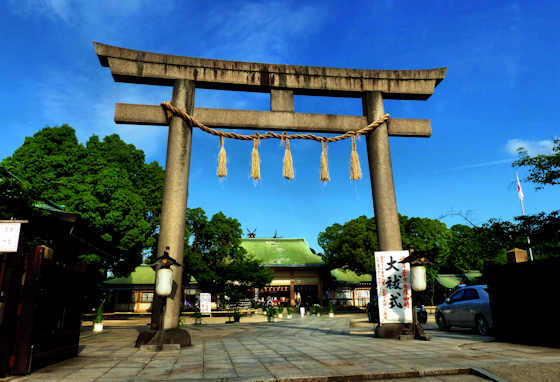
On the morning of the ninth day of my walk along the Saigoku Pilgrimage and the Kumano Kaido, I took a detour along a mini-pilgrimage to 3 shrines along the small Kishigawa Railway Line.


The first stop was Kamayama Shrine, enshrining Itsuse, the older brother of Jimmu, the mythical first emperor.


According to the story, Jimmu and his entourage had come up the Inland Sea, subduing the local tribes, but in the area now known as Osaka, they came upon a powerful enemy. Itsuse suggested that, as they were descendants of Amaterasu, the Sun Goddess, it was inauspicious for them to keep  attacking from the West, facing the rising sun; therefore they should head south into the Kii Peninsula and then come at the enemy from the East. Itsuse had been wounded by an arrow and later died from his wounds and was buried in the tomb behind the shrine.


As well as Itsuse, a whole slew of other kami are enshrined here, mostly the ancestor Kami of the main clans. On the left are enshrined Jimmu and the other two brothers of Jimmu and Itsuse. On the right: Takakuraji, a leader of the Kumano area, Umashimade, ancestor of the Mononobe, Amenohigata Kakushibigata, ancestor of the Omiwa, Amenotanekono, ancestor of the Nakatomi, Amenotomi, ancestor of the Imbe, Michiomi, ancestor of the Otomo, Okume, ancestor of the Kume, Shiinetsuhiko, ancestor of the Yamato, and Yatagarasu, ancestor of the Kamo.


The shrine was completely destroyed by Hideyoshi in the late 16th century. A small shrine was rebuilt in 1600 and then enlarged in 1669, however it was a very small shrine.


In early Meiji the shrine was enlarged in the campaign to elevate every site in the country connected to imperial history.


In 1938 it was massively expanded and rebuilt as part of the preparations for the 2,600th anniversary, in 1940, of the founding of the country by Jimmu. Around this time there was a veritable Jimmu mania.


The shrine has a hundred year old tradition for baby naming. As well as for babies, the shrine also offers the same service for naming a company or stage names etc.


As with other State Shinto sites, I found it sombre and austere, fitting, perhaps, as it is in essence a mausoleum.


It feels more like a European park in its layout and limited natural presence. There is no decoration nor "wild" nature.


From the shrine's website " The Greater East Asia War can be considered a success in that it brought us closer to eliminating racial discrimination and achieved the great objective of independence for East Asian countries, but our country itself suffered the full extent of the horrors of defeat."


So, the "horrors" of defeat overshadow the minimum of 20 million East Asian dead for this "success"


Shinto is being pushed as some kind of nature religion and spirituality, which certainly is part of it, but the dark, political State Shinto is still very much alive and thriving....


The previous post in this series was on the Kishigawa Railway which promotes this three-shrine pilgrimage.


If you would like to subscribe by email just leave your email address in the comments below. It will not be published and made public. I post new content almost everyday, and send out an email about twice a month with short descriptions and links to the last ten posts.


Monday, March 14, 2022

Ikutama Shrine

Ikutama Shrine


Ikutama is the common name for Ikukunitama Shrine, a very large shrine in Tennoji, Osaka, that I had not heard of but visited at the start of my second day walking the Kinki Fudo Myoo Pilgrimage. According to legend, it was founded by the mythical first emperor Jimmu.


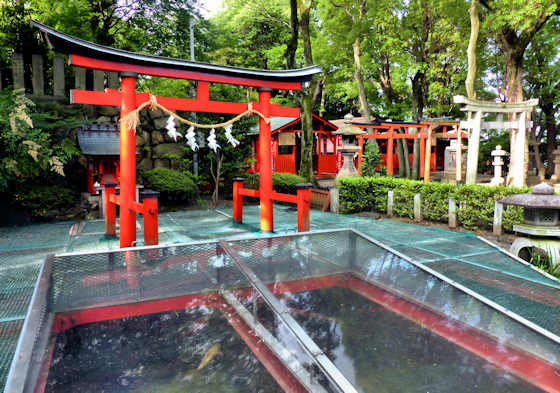
Ikutama Shrine has multiple sub-shrines within its grounds, including Inari, Tenmangu, Sumiyoshi, etc. This is Seichinsha, renamed from Benzaitensha in early Meiji. The shrine was located in a lotus pond but was moved to Ikutama Shairne when the pond was swallowed up by the construction of the subway. The large glass cover is over a small stream.


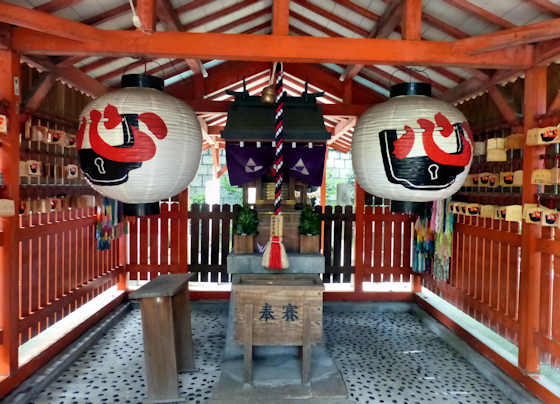
Shigino Shrine is another of the more well-known sub-shrines in the grounds. It is said that Hideyoshi's wife was a regular visitor. The symbol on the lanterns and ema is a lock with the florid kanji for "heart" and is said to be a good lace to ray for "connection", though it seems it may have been more concerned with breaking bad connections.


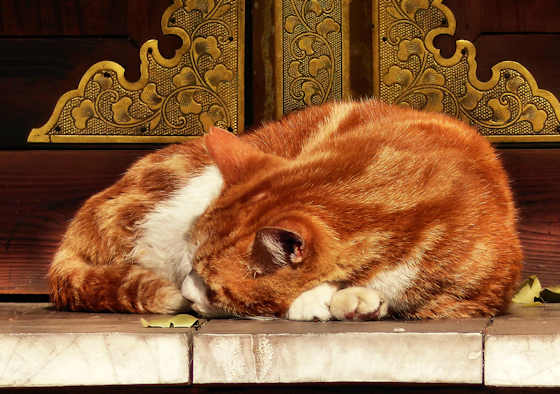
Apologies for adding a photo of a cat to the WWW..... Ikutama Shrine was moved to its current location by Hideyoshi. It was originally located closer to where Osaka Castle now stands and Hideyoshi had the shrine moved while building Osaka Castle.


The two main kami enshrined in Ikutama Shrine are Ukushimanokami and Tarushimanokami, neither of which aear in the ancient chronicles, and seemingly only one other shrine in Nagano enshrnes them.


A statue of Osak writer Sakunosuke Oda. I have never herd of him but the statue had to be a writer as he is wearing the "uniform" of one. Ikutama Shrine is also home to a Hikohachi Festival celebrating Yonezawa Hikohachi who is said to have created the Rakugo style of comedy here at the shrine.


An unusal set of direction signs pointing to the various "attractions" in the grounds of Ikutama Shrine.

Goods from Japan delivered to your home or business

Friday, September 4, 2020

Shirahige Shrine Asagiri

Shirahige Jinja


By lunchtime of the 40th day along the Kyushu Pilgrimage the mist had all disappeared and it was yet another glorious, late November day. After having stopped in at a handful of small, local shrines I reached a rather grander affair.


Shirahige Shrine was built at the base of a small mountain that once had a small castle and was the focal point for the area. It was a large shrine with multiple secondary shrines in the grounds and was obviously supported by the local lord of the castle.


There are a lot of Shirahige shrines around the country, branches of the Shirahige Shrine on lake Biwa near Kyoto. They enshrine a Korean king who settled in the Shiga area. This Shirahige shrine had no apparent connection with that one.


All the kami enshrined here relate to the founding myths of Jimmu, the mythical first emperorr. The primary kami is Ugayafukiaezu, the father of Jimmu, and also Hikohohodemi, hikoitsuse, and Inainomikpto are enshrined here.


There was also a dedicated area for archery, something only a few shrines have.

Friday, July 26, 2019

Princess Ahiratsu


Ahiratsu Hime was the first wife of the mythical first emperor Jimmu. This statue is in the small port town of Aburatsu in Nichinan, southerm Miyazaki.


According to the myth, when Jimmu left to invade central Japan and claim rulership, Ahiratsu chose to stay here and not go with him, although she had already given birth to a son that would become the mythical second emperor. Sorting out genealogies in the Japanse myths is complex as the myths as they stand today have evolved from a mass of tales and genealogies of the powerful clans, but is seems she was Jimmu's aunt....... seems like several of Jimmu's ancestors had also married aunts.....


Ahiratsu Shrine which enshrines her has been here since ancient times though it had a Buddhist influenced name before Meiji. It is a modern, concrete construction with several smaller shrines within the grounds. It is said that in a small tomb nearby mirrors and jewels were found indicating and ancient ruler.


On either side of the main altar were groups of four, small Lions, something I hadn't seen before....


Tuesday, June 25, 2019

The cave at Udo Jingu


The shrine, or rather shrines, at Udo Jingu are inside a cave in the cliff overlooking the sea. The main kami is named Ugayafukieazu, though there are variations on the name and its spellings. In the mythology, he was the father of Jimmu, the first emperor.


In the legend his mother, Toyotamahime constructed a birth hut here made out of cormorant feathers. and told her husband Hoori, sometimes known as Hohodemi or Yamasachihiko, not to look while she was giving birth as she would revert to her non-human form as the daughter of Ryujin, the undersea Dragon King.


He peeked and then freaked out at her appearance and she was so ashamed that she left the child and ran away. For some reason the shrine is considered lucky for newly-weds.


Deeper in the cave , behind the main shrine, are numerous smaller shrines that enshrine Yamasachihiko, Toyotamahime, Ninigi, Amaterasu, Jimmu, etc.


In the cave roof are rocks shaped like breasts. It is said that as a baby Jimmu suckled from them. The shrine sells a kind of candy made from the water that drips down the rocks.

Thursday, June 20, 2019

Udo Jingu


Udo Jingu is a major shrine in a stunning location on the coast of Nichinan in the south of Miyazaki. The original route to the shrine was over a mountain, and while a few still take this route, most use a big pedestrian tunnel that cuts through the mountain.


The shrine is located in a cave in the cliffs and to reach it the path is along the cifftop with great views out to see. It is connected to the Hyuga myths I posted about recently, and it is believed to be the place where Emperor Jimmu's father was born and some versions say that Jimmu was raised here.


The path drops down before reaching the cave. In the rocks on the shore below is one shaped like4 a turtle. In its back is a depression surrounded by a shimenawa. Visitors purchase small ceramic balls and attempt to throw them into the depression, which brings good luck.


Inside the cave and the story will folow shortly...

Saturday, June 15, 2019

The Hyuga Myth Cycle


Part of Aoshima Shrine near Miyazaki is a small museum with tableux displaying the cycle of myths set in Hyuga, the old name for what is now Miyazaki. This cycle of myths are now very well known, but historicaly there were many different versions of the myths. It is only in the modern period that one particular version has been established as the "national" myth. For instance, in this first scene we see Amaterasu, commonly known as the Sun Goddess, giving rice to her grandson Ninigi before his descent to Japan to establish rule over the country. However, several versions of the myth say it was not Amaterasu who sent Ninigi, but another kami. Also, on the 3 tables you can see the 3 imperial regalia, but it seems that for some of the ancient, powerful clans there were only 2 regalia.


Reaching Japan Ninigi took himself a wife and she miraculously became pregnant after only one night. Ninigi suspected the father may not be him and his wife was deeply offended by this. She chose to undergo an ordeal by fire to prove she was telling the truth and in the burning birthing hut she gave birth to 2 sons.


There are several stories about the brothers, but one of them has one brother visiting the undersea kingdom of the Dragon King where he is given some powerful magic objects.


After returning from under the sea he marries a princess who gives birth to a baby boy who grows up to be Jimmu, the mythical first "emperor" of Japan and he sets sail from Kyushu to subdue the tribes of Japan and establish the current ruling dynasty.


There are many variations of the stories, including many versions of the characters names and even their genealogies. There is far more diversity in Japanese myths, histories, cultures, and peoples than the monolithic, homogenous versions being spouted and taught today. In the late 19th Century the people of neighboring Kagoshima were horrified to hear that these myths took place in Miyazaki, as they had similar stories that took place in Kagoshima.